

Hyundai Ioniq 5 (EV) vs PHEV: Which One Is Better in 2025?
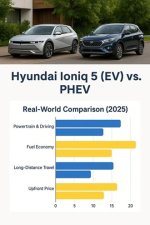
EV or Plug-In Hybrid in 2025 - Which Should You Actually Buy?
Drivers frequently search:
- “Ioniq 5 vs PHEV comparison”
- “EV vs PHEV real fuel economy 2025”
- “Is a plug-in hybrid worth it?”
This comparison gives you the real, practical, honest differences between an award-winning EV (Hyundai Ioniq 5) and a typical plug-in hybrid competitor (Hyundai/Kia PHEV models).
1. Powertrain & Daily Driving
Hyundai Ioniq 5 (EV)
- Smooth, quiet, instant torque
- Ideal for city & short trips
- Requires charging access
PHEV (Tucson / Sportage PHEV)
- EV mode for 30–70 km
- Gasoline engine for long trips
- Great if you charge daily
Winner: Tie
EV is better for cities.
PHEV is better for mixed driving only if charged often.
2. Real-World Fuel Economy (Important!)
Ioniq 5 EV
- 0 liters per 100 km
- Electricity cost ≈ 1/3 of gasoline
- Most economical option overall
PHEV models
- Charged daily: 2–4 L/100 km
- Charged sometimes: 5–7 L/100 km
- Never charged: 8–12 L/100 km (worst case)
Winner: EV - by far
A PHEV becomes extremely inefficient if not charged.
3. Range & Long-Distance Travel
Ioniq 5
- 384–507 km WLTP
- 800V architecture
- Ultra-fast charging (10–80% in 18 minutes)
- Best EV road-trip experience
PHEV
- Limited electric range
- Gas engine needed for long trips
- Fuel tank solves range anxiety
Winner: Depends on usage
If you hate charging on highways → PHEV wins.
If you charge often & drive under 300 km/day → EV wins.
4. Charging & Convenience
Ioniq 5
- Needs charging at home or work
- Best-in-class fast charging
PHEV
- Slow charging
- Can run on gasoline if needed
- Ideal for people without home charging
Winner: PHEV (for flexibility)
5. Maintenance & Long-Term Costs
Ioniq 5 (EV)
- Very low maintenance
- Fewer mechanical parts
- Battery degradation is minimal
PHEV
- Two powertrains = more complexity
- Higher maintenance risk
- Worst-case: engine + battery repairs
Winner: EV
6. Price & Value
EVs are becoming cheaper, but PHEVs often benefit from incentives.
- Ioniq 5: higher initial cost
- Tucson/Sportage PHEV: often cheaper upfront
- Running cost → EV much cheaper long-term
Winner: PHEV (upfront price)
Winner long-term: EV
Final Verdict — Ioniq 5 EV or PHEV?
Choose Ioniq 5 (EV) if:
You can charge at home
You want low running costs
You drive mainly city or mid-distance
You want the best EV tech in 2025
Choose a PHEV (Tucson/Sportage) if:
You cannot charge daily
You drive long distances often
You want gas backup for flexibility
You want lower upfront price
Conclusion
EVs are the future - but PHEVs still make sense for certain lifestyles.
The Ioniq 5 is a brilliant full EV, but a PHEV remains a smart choice only if you charge it frequently.