

Why many PHEVs are more trouble than you might expect
Before we dive into specific models, it’s worth understanding some of the systemic issues that make PHEVs prone to problems.
- According to J.D. Power, plug-in hybrids now have more reported problems (in the first 90 days) than battery electric vehicles. They score about 237 problems per 100 vehicles vs. 212 for BEVs.
- Similarly, Consumer Reports say PHEVs have ~70% more problems than conventional internal‐combustion vehicles (ICE) on average.
- Why? Because PHEVs combine two complex systems: a full petrol engine and transmission + electric motor + battery + charging system. More parts = more things that can go wrong.
So when you’re considering a PHEV from 2020-25, know that extra risk is built-in. With that in mind, here are five models that stand out for reliability concerns.
1. Ford Kuga PHEV (from ≈2020)
Major issues: high-voltage battery overheating/fire risk, random faults, inconsistent support.
- Several units were subject to a recall (Europe) due to the risk of battery short-circuit / fire in models from around 2020-22.
- The owners’ forums report failures of the 12 V battery triggering all sorts of faults: warning lights, infotainment, park-assist issues.
- What it means: A driver might suddenly face a “do not charge” advisory or a major service requirement. One user:“Just purchased a 2021 Ford Kuga PHEV … it had a faulty 12 v battery and has been subject to a safety recall on its HV battery.”
Bottom line: If you’re going for a Kuga PHEV, ensure all recall work has been done, check high-voltage battery condition and 12 V system history.
2. BMW X5 xDrive45e (approx 2020-22)
Major issues: complex cooling system, hybrid component durability concerns, expensive repairs.
- Owners report coolant pump failures, leaks in the hybrid cooling system (battery/emotor cooling).
- The reliability outlook is “less certain” as one reviewer put it:“The BMW X5 hybrid has a strong crash safety rating, but long-term reliability is less certain … plenty of complex electronics to go wrong.”
- On forums:“Three weeks and 500 miles after I picked up my 2022 45e, I suddenly had several faults: Charging Stopped and Drivetrain Malfunction.”
Bottom line: Premium brand & performance, but expect complicated service bills and check cooling/electrical subsystem history thoroughly.
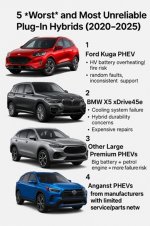
3. (Less well-documented, but worth caution) – other large premium PHEVs
While specific full reliability breakdowns are often sparse, the pattern for many big plug-in hybrids from luxury brands is: big battery + big petrol engine + heavy vehicle = more failure risk. For example: owners of various PHEV models report frequent “hybrid traction battery pack” issues, charging system faults, or sudden loss of electric mode.
When choosing these vehicles, look for: battery health reports, warranty on hybrid modules, service history showing hybrid-module repairs.
4 & 5. Let’s generalise: two more caution categories
Rather than naming exact models (due to limited data), here are two types of PHEVs to be very wary of:
A) PHEVs with small electric ranges
If a plug-in hybrid has only a short EV mode (say under 30–40 km real-world), you may rarely use the electric side, and the petrol engine runs more often - reducing the benefit and keeping you into petrol service patterns. Some reports show PHEV emissions/usage gaps are large.
Why it’s bad: You pay for the PHEV complexity, but you get little benefit, and more “both-systems” failure risk.
B) PHEVs from manufacturers with limited service/parts network for the hybrid components
If the battery pack, high-voltage modules or EV charging subsystem are niche for that brand or region, repair costs may be high, lead times long.
Tip: Check whether local market has trained service for high-voltage hybrid systems, availability of replacement battery components, warranty terms.
Key common failure-areas across PHEVs (2020-25)
Here are recurring trouble spots to watch when shopping/owning:
- High-voltage battery degradation/failure or overheating.
- Hybrid system coolant leak/failure - electric motor/battery need cooling.
- 12 V battery/auxiliary system triggered faults (even when HV is fine).
- Charging system errors or fail to charge.
- Software/infotainment issues (often cropping up more in PHEVs vs. ICE) – J.D. Power found touchscreen/infotainment problems are frequent in PHEVs.
- Real-world electric range significantly lower than claimed, reducing benefit and increasing cost.
- Poor resale value compared to simpler ICE/hybrid models because of uncertainty about battery life/cost.
Final verdict
If I were summarising:
- Buying a PHEV from 2020-25 can make sense, but only if you check all service history, battery health, recall status and are comfortable with potentially higher repair/maintenance cost.
- Among those models, the Ford Kuga PHEV and BMW X5 xDrive45e stand out for documented reliability concerns.
- Always factor in the “two-system” risk: petrol engine + electric system = more complexity.
- If you find a PHEV with strong real-world electric use, good battery warranty, transparent service history - then it may be worthwhile. Otherwise, a simpler hybrid (non-plug) or ICE might be more reliable and cheaper long-term.