

Used Car Test: Tesla vs Diesel Truck – The 1,000 km Real-World Challenge
Introduction: Electric Innovation vs Diesel Tradition
It’s the ultimate automotive face-off: cutting-edge electric technology versus old-school diesel power. For years, pickup trucks have ruled the highways of America tough, loud, and ready for anything. But now, the electric revolution is challenging that dominance.
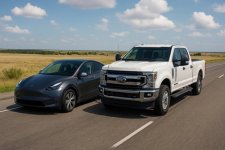
So we put it to the test: a Tesla Model Y Long Range against a used Ford F-250 Super Duty Diesel two vehicles that couldn’t be more different and took them on a 1,000 km journey to find out which one wins in the real world.
The goal: measure costs, time, comfort, and efficiency and reveal the truth behind the numbers.
The Rivals: Technology vs Muscle
To make the comparison fair, we picked two popular used vehicles:
- Electric: 2022 Tesla Model Y Long Range (Dual Motor AWD, ~60,000 km)
- Diesel: 2019 Ford F-250 Super Duty 6.7L Power Stroke V8 (~90,000 km)
Both vehicles are five-seaters with all-wheel drive and plenty of power. But that’s where the similarities end. One is built for efficiency and innovation, the other for raw towing strength and endurance.
The Route: 1,000 km of American Reality
The test route covered 1,000 kilometers (620 miles) from Dallas, Texas to Denver, Colorado, including long stretches of interstate, open plains, and steep mountain climbs.Weather was mild (around 18°C / 65°F), and both vehicles carried two adults and luggage about 200 kg of extra weight.
Charging and Refueling Plan
- Ford F-250: One full tank (136 liters / 36 gallons) before departure. Range: ~1,100 km. No refueling stops needed.
- Tesla Model Y: Full charge (82 kWh usable battery). Charging stops planned at Supercharger stations every 300–350 km.
The Tesla needed three charging stops, each around 25–30 minutes, using 250 kW Superchargers.
Energy Use and Costs
| Parameter | Tesla Model Y | Ford F-250 Diesel |
|---|---|---|
| Average consumption | 18.2 kWh / 100 km | 11.5 l / 100 km |
| Total energy used | 182 kWh | 115 liters |
| Energy cost | $0.28 / kWh (Supercharger avg.) | $1.20 / liter ($4.50 / gallon) |
| Total trip cost | $50.96 | $138.00 |
That’s a difference of nearly $90 per 1,000 km, in favor of the Tesla.
Even if charging prices rise or the driver uses more expensive stations, the EV remains dramatically cheaper per mile.
Time Comparison: The Diesel Advantage
While the Ford never had to stop, the Tesla’s three charging breaks added about 75 minutes total.
- Tesla total trip time: ~12 hours 10 minutes (including charging)
- Ford total trip time: ~11 hours flat
So the diesel saved just over one hour impressive, but not life-changing. And most Tesla drivers used those breaks for rest, food, or emails so the time wasn’t wasted.
Driving Experience: Quiet Speed vs Heavy Power
Tesla Model Y – Instant, Smooth, Silent
The Model Y’s instant torque made highway merging effortless. Passing traffic was as simple as tapping the pedal. The silence was striking — no vibration, no gear shifts, just clean acceleration.
Its low center of gravity and advanced traction control made the mountain sections surprisingly agile. Autopilot kept the car centered and relaxed during long stretches.
Ford F-250 – Muscle on Demand
The Super Duty truck delivered massive torque (over 1,000 Nm), making towing and uphill climbs feel easy. It’s the definition of “effortless grunt.”
But after hours on the highway, the diesel noise and slight cabin vibrations became noticeable. Its large body and heavy suspension made cornering and braking less refined.
Environmental Impact
Over the 1,000 km route:
- Tesla Model Y: ~18.2 kWh/100 km → ~80 kg CO₂ (based on US grid average)
- Ford F-250: 11.5 L/100 km → ~300 kg CO₂
That’s a threefold difference in emissions — and if the Tesla were charged using solar or renewable energy, its emissions would drop close to zero.
Maintenance and Reliability
Tesla
With no oil, no gearbox, and fewer moving parts, maintenance costs were significantly lower. Regular checkups include brake fluid, filters, and tire rotations that’s it.
Average annual maintenance cost: ~$400–500.
Ford F-250
The diesel truck required oil changes, fuel filters, DEF fluid, and turbo maintenance. While these trucks are known for durability, upkeep isn’t cheap.
Average annual maintenance cost: ~$1,200–1,500, especially for older models or heavy towing use.
Comfort and Technology
Tesla’s minimalist interior with the massive touchscreen feels like the future. Navigation automatically routes through Superchargers and displays real-time energy predictions. Cabin noise is minimal, and the seats stay comfortable even after 10 hours.
The Ford offers a commanding driving position and plenty of space, but its infotainment feels dated compared to Tesla’s software-driven approach. It wins on rugged practicality, not digital experience.
Long-Distance Reality: Pros and Cons
| Category | Tesla Model Y | Ford F-250 Diesel |
|---|---|---|
| Running cost (1,000 km) |  ~$50 ~$50 |  ~$138 ~$138 |
| Range convenience | Needs charging | 1,100 km per tank |
| Comfort & noise | Silent, smooth | Louder, rougher |
| Power delivery | Instant torque | Huge towing torque |
| Maintenance | Low cost | High cost |
| Environmental impact | ~70% less CO₂ | High emissions |
Verdict: The Future Is Quiet and Efficient
After 1,000 km, one thing is crystal clear:
Electric wins on cost, comfort, and cleanliness.
The Tesla Model Y was not only cheaper to run but also far more relaxing and modern to drive. Its software integration, range management, and performance made the entire trip feel effortless.
The diesel truck, however, still shines in areas that matter to traditional drivers: towing power, long range, and independence from charging networks. For those working in rural or off-grid environments, it remains unmatched for now.
But for daily life and long highway trips, the Tesla’s efficiency and refinement make the diesel feel like a relic of a noisier, dirtier past.
The numbers speak for themselves: over 1,000 km, the Tesla saved about $90, emitted 220 kg less CO₂, and offered a driving experience so calm that the diesel’s growl now feels like history.