

Due to the stagnation of the European electric car market, it is becoming increasingly difficult to maintain an optimistic outlook on the green transition. It's time to consider whether manufacturers have made enough effort to ensure that repairs on previously sold models are simple and reasonably priced for car owners. Renault likely did not consider this in the early 2010s, as otherwise, they would have developed repair technologies that not only offer safe and durable solutions for owners of early Kangoo and Fluence Z.E. electric cars but also economically feasible ones, taking into account the depreciation of the vehicles.
E-Service determined that the traction battery in David’s car was in perfect condition, with a calculated capacity of 60% of the original, as our reader had experienced during usage. This is also indicated by the fact that, according to receipts, he typically charged 15.5 kWh at public charging stations, which suggests a 60% battery capacity even after deducting charging losses. The error signal was eliminated by installing supplementary electronics at the Solymár service center, which made the battery management system detect a higher capacity than actual, while the real capacity remains measurable. The total repair cost was 203,000 HUF, (roughly $575) and the solution does not affect the safe operation of the car.
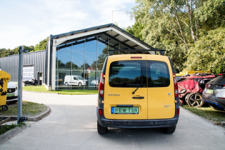
Fotó: Olvasónk, Dávid / Telex
According to György Nattán, head of E-Service, there's no need to fear that the power sources in the electric Kangoo or even the older Nissan Leaf and Renault Fluence Z.E. will suddenly fail. Based on experiences with these three models, these batteries wear out in a predictable manner, allowing owners of electric vehicles equipped with them to decide whether to part with their reduced-value Renault or Nissan, or continue using the car after replacing certain cell groups or the entire battery pack. According to the independent service, the cost of the latter varies, but in the case of the Kangoo Z.E., restoring the maximum range of around 200 km would cost about 1.5 million HUF. (roughly $4249). This is a far cry from the 17 million HUF (roughly $48,158) that Renault would charge for a mere 22 kWh battery for this model, the Fluence, and the early Nissan Leaf.
Renault’s 17 million HUF price (roughly $48,158) is starkly contrasted by Tesla's offer of a full 14-16 module battery pack for the Model S and Model X for a net price of 5-6 million HUF, ((roughly $ 14 146-16 997) according to György Zambelly, owner of the independent service center Teslavarázsló. As he told us, significant battery degradation is only found in the oldest, now 12-year-old examples of these cars, and complete replacement is rarely needed. More commonly, the car’s power source requires repair due to some other electronic failure or water damage, which can be resolved much more cheaply than the above figure by disassembling, drying, and repairing the battery pack, and then reassembling it after resealing. According to Zambelly, the more common Model 3 and Y batteries consist of 4 modules, but these packs can also be repaired by replacing individual modules if needed.
David’s case is not only instructive because it shows that official brand service centers do not always offer acceptable repair solutions for complex technical issues. It also highlights the importance of getting quotes from multiple places when a car’s warranty has expired and its value has significantly decreased, but the owner still wants to keep and continue using it. This logic applies to internal combustion engine vehicles as well, and if car manufacturers do not tap into the enormous opportunity presented by the professional yet economical repair of older vehicles, they will lose out on important revenue and many customers. Meanwhile, independent service centers will find these solutions and help used car owners in need.
A few weeks ago, readers could learn about David’s case on Telex. He has been leasing a 2014 electric Kangoo with only 90,000 km on the clock for his business since 2018. He uses the car daily for small delivery tasks and is very fond of it. The 22 kWh battery of the ten-year-old electric van only allows for about 90 km of range, but our reader values the zero local emissions, quiet operation, and free parking. David’s joy was cut short in early August when he took the car to the Baumgartner service center in Budapest for routine maintenance and soon received a quote that included not only the 164,000 HUF ($464) maintenance fee but also the price for replacing the entire battery pack, with the total coming to over 17 million HUF. (roughly $48,158)
It turned out that during diagnostics, the service center found a fault that, according to factory instructions, could only be fixed by replacing the battery. Baumgartner had not set up a workshop for disassembling and repairing electric vehicle battery packs, even cell group by cell group, as this would have involved expenses in the tens of millions. Additionally, factory-trained specialists, permits, and equipment would be required for an official Renault service center to handle such repairs.
David was advised by the company to take the Kangoo to the Duna Autó workshop, which has the necessary permits and equipment to repair the batteries of electric Renaults. However, this logic falters at this point. As we learned from the official importer, the first-generation Kangoo Z.E.s and the electric version of the Renault Fluence were built with battery packs that can only be replaced as a whole. Absurdly, the part costs as much as a new Tesla Model 3.
In early September, our reader took the still-operational Kangoo to a third, independent electric car repair shop, E-Service in Solymár, as the car would have failed its next technical inspection due to warning lights on the dashboard and the message "Elec system to check" on the display. Seeing these alone, any inspector could reasonably assume the Kangoo had a serious technical issue. However, as we learned from E-Service, these warnings typically appear in these cars when the battery's original capacity drops to 60%. The developers designed the early French electric cars to align with Renault’s battery rental subscription model, as this was intended to make the concept cheaper and more attractive. They did not foresee that the cars might later end up in private ownership with their batteries, and it now backfires since the battery pack can only be replaced as a whole, making it not worth it.
What do you think?
News
E-Service determined that the traction battery in David’s car was in perfect condition, with a calculated capacity of 60% of the original, as our reader had experienced during usage. This is also indicated by the fact that, according to receipts, he typically charged 15.5 kWh at public charging stations, which suggests a 60% battery capacity even after deducting charging losses. The error signal was eliminated by installing supplementary electronics at the Solymár service center, which made the battery management system detect a higher capacity than actual, while the real capacity remains measurable. The total repair cost was 203,000 HUF, (roughly $575) and the solution does not affect the safe operation of the car.
Fotó: Olvasónk, Dávid / Telex
According to György Nattán, head of E-Service, there's no need to fear that the power sources in the electric Kangoo or even the older Nissan Leaf and Renault Fluence Z.E. will suddenly fail. Based on experiences with these three models, these batteries wear out in a predictable manner, allowing owners of electric vehicles equipped with them to decide whether to part with their reduced-value Renault or Nissan, or continue using the car after replacing certain cell groups or the entire battery pack. According to the independent service, the cost of the latter varies, but in the case of the Kangoo Z.E., restoring the maximum range of around 200 km would cost about 1.5 million HUF. (roughly $4249). This is a far cry from the 17 million HUF (roughly $48,158) that Renault would charge for a mere 22 kWh battery for this model, the Fluence, and the early Nissan Leaf.
Renault’s 17 million HUF price (roughly $48,158) is starkly contrasted by Tesla's offer of a full 14-16 module battery pack for the Model S and Model X for a net price of 5-6 million HUF, ((roughly $ 14 146-16 997) according to György Zambelly, owner of the independent service center Teslavarázsló. As he told us, significant battery degradation is only found in the oldest, now 12-year-old examples of these cars, and complete replacement is rarely needed. More commonly, the car’s power source requires repair due to some other electronic failure or water damage, which can be resolved much more cheaply than the above figure by disassembling, drying, and repairing the battery pack, and then reassembling it after resealing. According to Zambelly, the more common Model 3 and Y batteries consist of 4 modules, but these packs can also be repaired by replacing individual modules if needed.
David’s case is not only instructive because it shows that official brand service centers do not always offer acceptable repair solutions for complex technical issues. It also highlights the importance of getting quotes from multiple places when a car’s warranty has expired and its value has significantly decreased, but the owner still wants to keep and continue using it. This logic applies to internal combustion engine vehicles as well, and if car manufacturers do not tap into the enormous opportunity presented by the professional yet economical repair of older vehicles, they will lose out on important revenue and many customers. Meanwhile, independent service centers will find these solutions and help used car owners in need.
A few weeks ago, readers could learn about David’s case on Telex. He has been leasing a 2014 electric Kangoo with only 90,000 km on the clock for his business since 2018. He uses the car daily for small delivery tasks and is very fond of it. The 22 kWh battery of the ten-year-old electric van only allows for about 90 km of range, but our reader values the zero local emissions, quiet operation, and free parking. David’s joy was cut short in early August when he took the car to the Baumgartner service center in Budapest for routine maintenance and soon received a quote that included not only the 164,000 HUF ($464) maintenance fee but also the price for replacing the entire battery pack, with the total coming to over 17 million HUF. (roughly $48,158)
It turned out that during diagnostics, the service center found a fault that, according to factory instructions, could only be fixed by replacing the battery. Baumgartner had not set up a workshop for disassembling and repairing electric vehicle battery packs, even cell group by cell group, as this would have involved expenses in the tens of millions. Additionally, factory-trained specialists, permits, and equipment would be required for an official Renault service center to handle such repairs.
David was advised by the company to take the Kangoo to the Duna Autó workshop, which has the necessary permits and equipment to repair the batteries of electric Renaults. However, this logic falters at this point. As we learned from the official importer, the first-generation Kangoo Z.E.s and the electric version of the Renault Fluence were built with battery packs that can only be replaced as a whole. Absurdly, the part costs as much as a new Tesla Model 3.
In early September, our reader took the still-operational Kangoo to a third, independent electric car repair shop, E-Service in Solymár, as the car would have failed its next technical inspection due to warning lights on the dashboard and the message "Elec system to check" on the display. Seeing these alone, any inspector could reasonably assume the Kangoo had a serious technical issue. However, as we learned from E-Service, these warnings typically appear in these cars when the battery's original capacity drops to 60%. The developers designed the early French electric cars to align with Renault’s battery rental subscription model, as this was intended to make the concept cheaper and more attractive. They did not foresee that the cars might later end up in private ownership with their batteries, and it now backfires since the battery pack can only be replaced as a whole, making it not worth it.
What do you think?
News