

Tesla Model S / X Battery Heater Module Failure - What Really Goes Wrong (and How We Fix It)
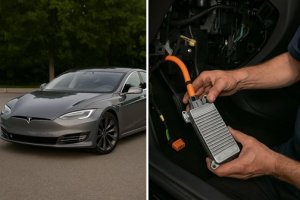
If you’ve ever owned a Tesla Model S or X, you already know that these cars are basically rolling computers with a rocket engine attached. But like every piece of advanced engineering, they still have weak points and one of the most common troublemakers hiding under the floor is the battery heater module.
Yes, the little metal box whose job is to keep a giant battery warm.
Yes, the one you never think about until it fails.
And yes… the one in the picture on my workbench that decided to call it quits on a perfectly ordinary Tuesday.
Let me walk you through how these modules fail, why they fail, the symptoms owners experience, and what a real-world repair looks like including a clear USD/EUR cost estimate.
And don’t worry I’ll keep it technical but entertaining. After all, if I spent hours wrestling with high-voltage components and orange cables, the least I can do is make the blog fun for you.
What the Battery Heater Module Actually Does
In a Tesla, the battery pack must stay within an optimal temperature range for:
- charging
- discharging
- longevity
- supercharging performance
- and, of course, basic survival during winter
No functioning heater =
no fast charging
reduced power
charging disabled in winter
angry warning messages
a driver questioning their life decisions
The irony?
This small module can bring a $60,000–$120,000 car to its knees.
How the Failure Usually Starts
Over time, several things can go wrong:
 Internal corrosion
Moisture slowly sneaks into the module housing.
Once inside, it corrodes the electronics and electronics do not like spa days.
 Thermal cycling fatigue
Repeated heating and cooling causes solder joints and seals to weaken.
Imagine bending a paperclip over and over eventually, it snaps.
 Coolant contamination
If the coolant system wasn’t perfectly flushed or sealed, small contaminants can cause premature wear.
 Electrical overload / shorting
The module draws significant power when active. A minor short = instant failure.
 High-voltage connector degradation
That chunky orange cable isn’t just for show it carries real power.
If the connector pins corrode, you get resistance → heat → damage → module death.
Common Symptoms of a Tesla Battery Heater Failure
If your heater module is thinking about retirement, your Tesla will likely show:
- “Battery heating unavailable”
- “Charge rate reduced”
- “Regenerative braking limited”
- Extremely slow Supercharging
- In freezing weather: charging may be blocked completely
Sometimes the car will try to warm the battery using motor waste heat which works about as well as heating your living room with a hair dryer.
Diagnosis - How I Confirm the Failure
The moment a Tesla rolls into the workshop with cold-pack symptoms, I check:
Coolant flow
If the pump is working but temperature doesn’t rise → heater likely dead.
Resistance readings
A healthy heater module has a predictable resistance range.
If it’s off by more than 10–15% → internal fault.
High-voltage fault codes
Tesla logs everything.
These logs usually tell the truth… eventually.
Physical inspection
In your screenshot, you can see the classic scenario:
module removed, orange HV cable detached, and all the tools scattered around like a crime scene.
If you ever want to see what these parts generally look like, typical heater-module shapes resemble components in EV thermal systems like those shown here:
evparts.com
Repair Process - Step by Step
1. Vehicle powered down + HV system safe mode
You never touch orange cables unless you enjoy electricity more than the average person.
2. Coolant drained
Because yes, Tesla uses coolant.
No, it's not unicorn tears just standard automotive coolant.
3. Heater module removal
Bolts out, hoses off, electrical connectors removed.
This is where most people take a break and question career choices.
4. New module installation
Fresh seals, cleaned connectors, new heater installed.
5. Coolant refill + vacuum bleed
Air bubbles and electric cars get along about as well as cats and baths.
6. Software reset + test cycle
Tesla does a final check, spins its virtual wheels, and gives the OK.
Realistic Cost Breakdown (USD & EUR)
Here’s what customers always want to know:
Parts (material cost)
Depending on model and year:
- Replacement heater module:
$380–$520 USD
€350–€480 EUR - Coolant + sealing materials:
$40–$60 USD
€35–€55 EUR
$420–$580 USD
€385–€535 EUR
Labor cost
Typical job time: 3.0–4.0 hours
- Labor rate:
$90–$120 USD/hour
€80–€110 EUR/hour
$270–$480 USD
€240–€440 EUR
Full repair estimate
| Cost Type | USD | EUR |
|---|---|---|
| Materials | $420–$580 | €385–€535 |
| Labor | $270–$480 | €240–€440 |
| Total | $690–$1,060 | €625–€975 |
Why Does Tesla Still Have This Issue?
Great question. I ask myself the same thing every winter.
In my experience:
- The heater module is exposed to constant moisture.
- Temperature swings are extreme.
- The internal sealing is good but not great.
- Long-term corrosion wins the battle.
A Little Humor From the Workshop
Every time I remove a failed heater module, I imagine it whispering:
“I warmed thousands of kilowatt-hours for you…
and THIS is the thanks I get?”
Meanwhile, the new module sits on the bench like:
“Don’t worry, boss. I’ll last at least until 2030.”
(Probably. Maybe. Hopefully.)
Final Thoughts - What Owners Should Know
If you own a Tesla Model S or X, especially older pre-refresh versions, sooner or later the heater module may fail.
The good news?
- It’s fully replaceable
- Does not require opening the battery pack
- Can be done in a single day
- After repair, charging performance improves instantly
Last edited by a moderator:


