

 Bold Design & Aerodynamics
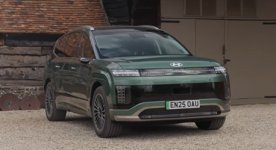
- The IONIQ 9 adopts Hyundai’s signature “Aerosthetic” styling: clean, flowing lines, pixel‑style LEDs, grille‑less front, and flush surfaces. Remarkably, it achieves a low drag coefficient of ≈0.259 Cd, aided by active air flaps and underbody smoothing
- At over 5 m long, with a 3.13 m wheelbase, it’s Hyundai’s largest model yet—a true three-row SUV built for space and presence
🛋 Cabin & Versatility
- The interior feels palatial: flat floor, high ceilings, and seating for six or seven. The second row can swivel 180° to face the third row, ideal for family talks or charging breaks
- Features include Relaxation Seats with leg rests, a sliding “Universal Island 2.0” center console accessible from both rows, and multiple USB‑C ports delivering up to 100 W power in all seats
- Boot space ranges from ≈338 L behind the third row to over 1,323 L with the third-row folded—and nearly 2,419 L if you fold all rear seats. There's also a compact front frunk
 Performance, Range & Charging
- A 110.3 kWh battery is standard on all trims, supported by an 800‑volt charging architecture enabling DC fast charging from 10% to 80% in just 24 minutes on a 350 kW charger. The car supports Tesla’s NACS port for Supercharger access
- Powertrain options include:
- Long Range RWD: ~215 hp, ~335 mi EPA range, 0‑60 mph in about 8.4 s
- Long Range AWD: ~303 hp, ~320 mi range, 0‑60 mph in ~6.2 s
- Performance AWD: ~422 hp, ~311 mi range, 0‑60 mph in ~4.9–5.2 s depending on wheel size
 Tech & Comfort Highlights
- Dual 12.3‑inch curved displays for the instrument cluster and infotainment, integrated with intuitive physical buttons and steering‑wheel controls; BOSE 14‑speaker premium stereo available with surround sound and virtual EV sound design
- Quietness is notable: acoustic glazing, noise-absorbing tires, and ANC‑R active noise cancellation keep cabin serenity even on rough roads
- Additional tech features: Highway Driving Assist 2 with hands‑on lane‑centering and auto lane changes, driver monitoring, OTA updates, V2L power outlet for camping, and FoD (Features on Demand) option store
 Driving & Real-World Usability
- Ride quality is mostly composed at highway speeds, though low-speed urban road texture can feel slightly unsettled—some firmness noticeable over rough patches.
- The SUV’s size makes visibility a concern, but optional rearview camera mirror and 360° surround‑view camera help in tighter maneuvering (available on SEL and higher trims)
 Pricing & Market Launch
- U.S. pricing is expected to fall in the range of $60,500 to $78,000 before incentives, with full eligibility for the $7,500 federal EV tax credit
- Shipping from Hyundai’s Metaplant in Georgia, with U.S. and Korea launch in H1 2025, followed by Europe later in the year
 Pros &
  Cons at a Glance
Pros:- Exceptional space and comfort, including swiveling seats and ample cargo volume
- Impressive range and fast charging thanks to 800V architecture
- Advanced sound insulation and quiet cabin
- Rich interior technology and family-oriented flexibility
- Competitive pricing for luxury-level EV features and tax incentives
Cons:- Ride can feel firm over uneven urban roads
- Materials aren’t quite on par with high-end rivals like Volvo EX90 or BMW iX
- Its size—while spacious—may challenge maneuverability in tight city environments
- Some design and infotainment choices may feel conservative rather than sporty
 Verdict: Has the “Spaceship Landed”?
Yes—and in style. The IONIQ 9 redefines what Hyundai can offer in electric SUV luxury, but at a more accessible price than premium competitors. It's a clever blend of futuristic design, spacious comfort, and practical tech, especially for families or long-distance travelers. While it may lack the full-polish materials of ultra-lux brands, its value, charging performance, and thoughtful versatility make it a standout in the new-wave large EV segment.