

Hydrogen Cars: The Future of Clean Mobility or a Road to Nowhere?
When we talk about the future of sustainable transportation, electric vehicles (EVs) dominate the headlines. Tesla, Rivian, Hyundai, and Ford are all fighting for dominance in the battery-electric market. But there’s another, quieter contender that has been promising “zero-emission driving” for decades the hydrogen fuel cell vehicle (FCEV).
While hydrogen cars sound futuristic, their presence on U.S. roads remains vanishingly small. Only a handful of models exist, like the Toyota Mirai, Hyundai Nexo, and Honda Clarity Fuel Cell, and almost all of them are sold or leased exclusively in California. Why? Because the reality behind the technology is far more complicated than the marketing.
Let’s take a closer look at whether hydrogen cars represent a true alternative for the future — or if they’re heading toward a technological dead end.
How Hydrogen Cars Work
Hydrogen fuel-cell vehicles run on the cleanest energy source in the universe hydrogen. Instead of burning fuel like a gasoline engine, the car uses a fuel cell stack to combine hydrogen with oxygen from the air, producing electricity, heat, and water vapor as the only emission.
In essence, a hydrogen car is an electric car, but instead of storing energy in a large battery, it creates electricity on demand. The fuel cell powers the motor, while a small buffer battery smooths out energy flow.
On paper, it’s a perfect concept: zero tailpipe emissions, five-minute refueling, and driving ranges that rival gasoline cars usually around 300–400 miles per tank.
The Infrastructure Problem
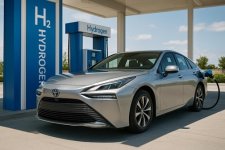
Here’s where the promise meets reality. Hydrogen fueling infrastructure in the United States is extremely limited. According to data from the U.S. Department of Energy’s Alternative Fuels Data Center, there are fewer than 100 public hydrogen stations, and almost all of them are located in California.
This means that even if you own a hydrogen car, your driving radius is constrained to a small geographic region. Outside California, the nearest hydrogen pump could be hundreds of miles away.
Hydrogen fuel stations are also expensive to build around $1–2 million per location, and they require constant maintenance, safety systems, and high-pressure tanks. For comparison, adding a high-speed EV charger costs roughly $50 000–$200 000, a fraction of the investment.
Until a national network of hydrogen stations exists, fuel-cell vehicles remain impractical for most Americans.
Hydrogen Production: Not So Green (Yet)
Hydrogen is the most abundant element in the universe, but on Earth it’s not freely available it must be extracted. And how we produce it makes all the difference.
Currently, over 95% of hydrogen in the U.S. is made through steam methane reforming, which uses natural gas. This process releases significant amounts of CO₂, defeating much of hydrogen’s environmental advantage.
The cleaner method, electrolysis, splits water into hydrogen and oxygen using electricity. But unless that electricity comes from renewable sources like wind or solar, the process still carries a carbon footprint. Moreover, electrolysis remains energy-intensive and expensive.
So while “green hydrogen” is technically possible, it is not yet scalable or cost-competitive. The irony is clear: hydrogen cars are zero-emission at the tailpipe, but the hydrogen they run on is often fossil-fuel-based.
Storage and Transport: The Hidden Challenges
Even after production, hydrogen presents a logistical nightmare.
Hydrogen gas must be compressed to 10,000 psi or cooled to -253 °C for storage both demanding specialized tanks and pipelines. Unlike gasoline or electricity, hydrogen cannot easily be moved through existing infrastructure.
Leaks are another issue. Hydrogen molecules are tiny, meaning they can escape through micro-cracks in pipes and valves, posing safety and efficiency concerns.
Because of these factors, transporting hydrogen from production sites to fueling stations is complex and costly, further driving up the pump price — which typically ranges between $10–$20 per kg. For a full tank, that’s roughly $120–$160 per refill for many FCEVs, comparable to or even higher than gasoline costs.
Hydrogen vs. Battery EVs
Hydrogen cars have some undeniable advantages over battery EVs:
- Refueling time: 3–5 minutes versus 30–60 minutes (even on fast chargers).
- Driving range: often greater than 350 miles, comparable to gas cars.
- Cold-weather performance: FCEVs lose less range in freezing temperatures.
- Charging network: thousands of public chargers nationwide (and growing fast).
- Efficiency: EVs convert about 70–80% of grid energy into motion; FCEVs only about 30–40% after accounting for hydrogen production and compression.
- Maintenance: fewer moving parts, simpler systems.
- Energy cost: home charging is far cheaper than hydrogen refueling.
Who’s Still Investing in Hydrogen Cars?
Despite the challenges, several automakers continue to invest in fuel-cell technology.
- Toyota remains the strongest advocate, calling hydrogen “the missing link” between renewables and transportation.
- Hyundai offers the Nexo, one of the few FCEVs on sale in 2025.
- BMW, Honda, and Hyundai are exploring hydrogen-powered trucks and commercial fleets where centralized refueling might make sense.
The remaining hope for hydrogen lies in heavy-duty applications: freight transport, long-haul trucking, shipping, and industrial power generation sectors where batteries are too heavy or slow to recharge.
The Environmental Equation
The potential of hydrogen depends entirely on the source of the hydrogen.
- If it’s produced via fossil fuels, hydrogen vehicles offer limited environmental benefit.
- If it’s made using renewable energy (green hydrogen), the results could be game changing truly zero-emission mobility with rapid refueling.
Until that happens, hydrogen cars will remain a niche solution, attractive mainly to governments and corporations looking to test alternatives beyond batteries.
So, Is Hydrogen a Dead End or a Long-Term Bet?
Hydrogen isn’t dead but it’s stuck in limbo.
Right now, hydrogen fuel-cell cars are too expensive, too inconvenient, and too limited in fueling infrastructure for mass adoption. Battery-electric vehicles have surged ahead, supported by public charging networks, cheaper renewable electricity, and a booming ecosystem of suppliers.
However, hydrogen still has a future just not necessarily in your driveway. Its best chance lies in heavy transport, aviation, and industrial decarbonization, where batteries can’t deliver the required range or power density.
In short:
Hydrogen cars are an incredible piece of engineering but in 2025, they’re more a proof of concept than a practical reality.
The next decade will determine whether hydrogen becomes a cornerstone of clean energy — or remains a fascinating, over-engineered detour on the road to sustainability.
Key Takeaway
Hydrogen fuel-cell vehicles offer the dream of zero-emission driving, but the current reality is defined by infrastructure gaps, production inefficiency, and high costs. Until green hydrogen becomes affordable and available nationwide, FCEVs will stay in the shadow of battery-electric cars.
Still, as technology evolves and nations push for carbon neutrality, hydrogen’s story may not be over it’s just waiting for its spark.