

The cost difference between driving an EV and an ICV varies significantly depending on several factors, including local electricity and gas prices, government incentives, and regional infrastructure. Here's an analysis of how these factors impact the cost of driving EVs versus ICVs across different parts of the United States:
Cost Comparison
Electricity vs. Gasoline Prices:
Electricity Costs: On average, charging an EV at home costs around 13 cents per kWh in the U.S., which translates to roughly $0.04 per mile driven, based on the efficiency of EVs (typically 3-4 miles per kWh) .
Gasoline Costs: Gas prices can fluctuate widely, but as of 2024, the national average is approximately $3.50 per gallon . With the average fuel efficiency of gasoline vehicles being around 25 miles per gallon, this translates to about $0.14 per mile driven .
Regional Variations:
California: Electricity prices are higher than the national average, but gas prices are also among the highest in the country. The cost of charging an EV remains significantly lower than refueling a gasoline vehicle .
Texas: Gas prices tend to be lower, and electricity prices are closer to the national average. The savings from driving an EV might not be as pronounced compared to California, but EVs still offer cost advantages .
New York: High gas prices and relatively high electricity costs still make EVs cheaper to operate compared to gasoline vehicles .
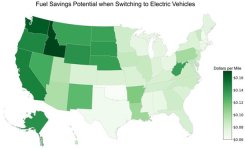
(VIA DOE)
Potential Savings
Fuel Savings: On average, driving an EV can be up to 50-60% cheaper than driving a gasoline vehicle, based on energy costs alone .
Maintenance Savings: EVs generally have lower maintenance costs due to fewer moving parts and no need for oil changes, further enhancing savings over time .
Other Factors Influencing Costs
Government Incentives: Federal and state tax credits can significantly reduce the upfront cost of purchasing an EV. These incentives vary by state, affecting the overall cost-effectiveness of owning an EV .
Charging Infrastructure: Regions with extensive charging infrastructure make it more convenient and potentially cheaper to charge EVs, as public chargers can offer different pricing schemes .
Environmental and Long-term Benefits: Beyond immediate cost savings, EVs offer environmental benefits, which can lead to longer-term societal cost savings, such as reduced healthcare costs associated with air pollution .
Conclusion
While EVs can be significantly cheaper to drive than ICVs, the actual savings vary across the country. Factors such as local energy prices, incentives, and infrastructure play critical roles in determining the cost-effectiveness of EVs. As EV adoption increases, these factors are likely to become even more favorable, enhancing the economic and environmental benefits of transitioning to electric vehicles .
Cost Comparison
Electricity vs. Gasoline Prices:
Electricity Costs: On average, charging an EV at home costs around 13 cents per kWh in the U.S., which translates to roughly $0.04 per mile driven, based on the efficiency of EVs (typically 3-4 miles per kWh) .
Gasoline Costs: Gas prices can fluctuate widely, but as of 2024, the national average is approximately $3.50 per gallon . With the average fuel efficiency of gasoline vehicles being around 25 miles per gallon, this translates to about $0.14 per mile driven .
Regional Variations:
California: Electricity prices are higher than the national average, but gas prices are also among the highest in the country. The cost of charging an EV remains significantly lower than refueling a gasoline vehicle .
Texas: Gas prices tend to be lower, and electricity prices are closer to the national average. The savings from driving an EV might not be as pronounced compared to California, but EVs still offer cost advantages .
New York: High gas prices and relatively high electricity costs still make EVs cheaper to operate compared to gasoline vehicles .
(VIA DOE)
Potential Savings
Fuel Savings: On average, driving an EV can be up to 50-60% cheaper than driving a gasoline vehicle, based on energy costs alone .
Maintenance Savings: EVs generally have lower maintenance costs due to fewer moving parts and no need for oil changes, further enhancing savings over time .
Other Factors Influencing Costs
Government Incentives: Federal and state tax credits can significantly reduce the upfront cost of purchasing an EV. These incentives vary by state, affecting the overall cost-effectiveness of owning an EV .
Charging Infrastructure: Regions with extensive charging infrastructure make it more convenient and potentially cheaper to charge EVs, as public chargers can offer different pricing schemes .
Environmental and Long-term Benefits: Beyond immediate cost savings, EVs offer environmental benefits, which can lead to longer-term societal cost savings, such as reduced healthcare costs associated with air pollution .
Conclusion
While EVs can be significantly cheaper to drive than ICVs, the actual savings vary across the country. Factors such as local energy prices, incentives, and infrastructure play critical roles in determining the cost-effectiveness of EVs. As EV adoption increases, these factors are likely to become even more favorable, enhancing the economic and environmental benefits of transitioning to electric vehicles .