

Don’t Buy a RAV4 Until You Read This! 2025 vs 2026 Breakdown
Update – 2026
This article has been refreshed with improved details, clearer explanations, and refined insights to ensure a more accurate and user-friendly reading experience. The core content remains the same, but the update enhances usability, reliability, and overall relevance.
The compact‐SUV market, the Toyota RAV4 continues to be a major player. As the model transitions from its 2025 to 2026 version, Toyota is staging a meaningful shift not just minor tweaks but a substantive upgrade in powertrain, electronics, and overall positioning. If you’re considering a RAV4, knowing the differences between the 2025 and 2026 model years will help you decide whether to buy now or wait.
1. Overview: What’s the big picture?
The 2025-model RAV4 represents the outgoing version of this generation and offers conventional hybrid, plug-in hybrid and in some markets even combustion‐engine variants. The 2026 model, on the other hand, ushers in a new phase: Toyota is moving the RAV4 to an all-electrified (hybrid or plug-in hybrid only) lineup.
In other words:
- 2025: A “standard” RAV4 offering with internal combustion + hybrid/PHEV options.
- 2026: A “next generation” RAV4 (sixth generation in many markets) focused solely on electrified powertrains (hybrid / PHEV), with upgrades in tech and performance.
Thus, the shift is more than cosmetic it reflects Toyota’s strategy to embed hybrid electrification into this core model.
2. Powertrain & performance differences
One of the biggest areas of improvement between 2025 and 2026 is under the skin: the hybrid and plug-in hybrid systems are upgraded.
2025 model highlights
- The 2025 RAV4 still has a variety of powertrains (depending on region) including hybrid and plug-in hybrid (PHEV) options.
- For example, the PHEV version in 2025 offers an all-electric (EV) range of about 42 miles (≈ 67 km) in the U.S. market.
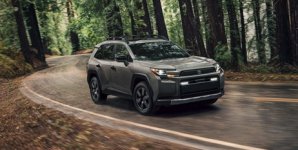
https://www.toyota.com
2026 model upgrades
- The 2026 RAV4 moves to a more advanced plug-in hybrid system (sixth-generation PHEV in some markets) with up to ~320 horsepower (or near that) combined system output an increase over the 2025 PHEV.
- The EV-only range jumps up (in the U.S. estimate) from ~42 miles to ~50 miles for the PHEV.
- All models for 2026 are hybrid or PHEV pure internal-combustion only variants are being phased out (in many key markets).
What this means in real terms
- If you choose a 2026 PHEV RAV4, you’ll get stronger performance (more horsepower), better EV driving capability, and more forward-looking efficiency.
- The standard hybrid models also benefit from updated architecture. (Though in some markets, nuances such as tuning change.)
- For the 2025 model, the advantage is that you still have the proven systems and potentially lower purchase price (and more deals) now.
3. Technology, infotainment & cabin upgrades
Beyond the drivetrain, Toyota has substantially upgraded the in-car tech for 2026.
Infotainment & cockpit
- In the 2025 RAV4, many trims come with an 8.0-inch centre touchscreen as standard, and up to a 10.5-inch unit in higher trims.
- For the 2026 model year: Standard infotainment jumps to a 10.5-inch centre touchscreen; available up to 12.9 inches on higher trims.
- Moreover, 2026 introduces Toyota’s new “Arene” software platform which underpins the latest infotainment, connectivity and future-proof features (OTA updates, etc.).
Interior & cabin refinements
- While the basic architecture (platform, wheelbase) remains similar (in many markets) between the outgoing and incoming RAV4, Toyota has strengthened structural elements, revised suspension mounts, improved NVH (noise/vibration/harshness) and updated materials.
- The new model presents a more premium feel, improved driver assistance technologies, and upgraded layout for screens and controls.
Safety & driver assistance
- The 2026 model brings advanced versions of the safety suite (Toyota Safety Sense) including new features like front cross-traffic alert, lane change assist, predictive curve speed control.
- These improvements reflect Toyota’s push toward delivering “software-defined” vehicles.
4. Design, styling & refinement
From style to details, the 2026 RAV4 gets visual updates (though it’s an evolution rather than full redesign) and a refinement in build quality.
Exterior
- The overall body size and platform carry over in many markets, but the styling is fresh: sharper lines, updated front fascia, possibly new wheel/suspension tuning.
- For buyers who care about “looks”, the 2026 model will appear more modern and aligned with Toyota’s current design language.
Interior feel & materials
- Improved infotainment and better integration of tech help the cabin feel more contemporary in the 2026 version.
- The 2025 model remains very capable and practical but might feel slightly less advanced in comparison to the 2026’s tech iteration.
5. Practicality, space and usability
When it comes to cargo space, seating, ride comfort etc., what changes?
- According to available info, Toyota hasn’t published major dimensional changes for the 2026 RAV4 in many markets—so you can expect similar cabin and cargo volumes as the 2025 model.
- For example: In a 2025 RAV4 test, they fitted 10 carry-on suitcases behind the back seat and 22 with the rear seats folded.
Thus: The key practicality strengths of the RAV4 (good cargo, versatile seating, AWD options) carry over.
6. Pricing and value – now vs waiting
If you’re deciding between buying now (2025) or waiting (2026), pricing and value are big factors.
- The 2025 RAV4 has the advantage of current inventory, probably more promotional deals, and a lower entry price compared to what the new 2026 will launch at.
- In contrast, the 2026 model with its enhanced technology and electrified drivetrain may carry a price premium.
- If you buy 2025 now, you may capture a good deal but you’ll have slightly older tech and lower PHEV capability.
- If you wait for 2026, you’ll get the more future-oriented car but might pay more and wait for availability.
7. Which one should you choose? - Decision matrix
| Scenario | Choose 2025 RAV4 | Choose 2026 RAV4 |
|---|---|---|
| Budget-sensitive & want to buy now | Great value, lower cost, proven drivetrain | You’ll miss the tech and PHEV improvements |
| You want latest tech, stronger PHEV performance and future-proofing | You’ll be buying soon-to-be-outdated specs | Best choice for long term, higher resale, latest features |
| You need immediate delivery (no wait) | Go with 2025 | 2026 likely means wait / maybe higher cost |
| You prioritise lowest price over technology premium | 2025 | 2026 will cost more |
| You care about maximum EV-only range / hi-tech infotainment / refined hybrids | 2025 less advanced | 2026 delivers more |
8. Key take-aways
- The shift from 2025 → 2026 in the Toyota RAV4 is substantial, particularly in hybrid/PHEV capability, infotainment/tech, and electrification strategy.
- If you buy the 2025 version today, you’ll get a very good vehicle but you’ll have “last year’s” tech.
- If you wait for the 2026, you’ll benefit from the upgrades but you might wait for availability and pay a premium.
- From the perspective of long-term ownership (resale value, technology longevity), the 2026 model is more future-proof.
- For many buyers, a well-equipped 2025 model may hit the sweet spot of value vs capabilities just be aware of the coming changes.
9. Final word
If I were summarising in one sentence: The 2026 RAV4 is where Toyota brings the RAV4 into the next era of electrified SUVs, while the 2025 remains a strong and sensible choice today but slightly behind in tech and efficiency.
If your timeline allows, and you value the newer infotainment, improved EV range (for PHEV), and newer hybrid architecture, then waiting for the 2026 model makes sense. If you need to make a purchase now, or want to capture value, the 2025 model remains a very capable SUV with the dependable RAV4 DNA.
Last edited:


