

Key Takeaways
- Nissan is positioning the 2026 Rogue as a more compelling value — with a significant price drop (especially on the Rock Creek trim) plus a new “Dark Armor” trim to attract style-oriented buyers.
- The underlying powertrain remains the 1.5 L turbocharged three-cylinder with ~201 hp, 225 lb-ft torque, mated to a CVT (Xtronic) in many trims.
- A plug-in hybrid (PHEV) variant is expected, delivering a combined output (engine + electric) of ~248 hp and a modest EV driving range.
- The Rogue gets more aggressive styling options, new trim differentiation, and tweaks to feature packages (e.g. removing or combining certain optional packages) to simplify the lineup.
- Safety, interior tech, and comfort updates aim to keep it competitive in the compact SUV segment.
Overview of the 2025 Model (Baseline)
To understand what changes might carry over or be improved in 2026, here’s a brief on the 2025 Rogue:
- The 2025 Rogue is powered by a turbocharged 1.5 L three-cylinder engine making 201 hp, mated to a CVT.
- It comes in several trims (S, SV, Rock Creek, SL, Platinum) with front-wheel drive or available all-wheel drive.
- Standard and optional safety and driver-assist features are robust: Nissan Safety Shield 360 (braking, blind-spot, cross-traffic, lane departure, high-beam assist) is standard.
- Crash-test results (for 2025) are mixed: in IIHS, the Rogue scores “Good” in many crashworthiness categories, but has some weaker ratings for pedestrian detection (front crash prevention) in certain configurations.
- Interior features include an available 12.3″ touchscreen, Google built-in in higher trims, memory driver’s seat, heated seats, heated steering wheel, and various comfort / connectivity enhancements.
- Cargo and space are competitive for the class.
What to Expect in 2026: Key Features, Updates & Innovations
Design / Aesthetics Updates
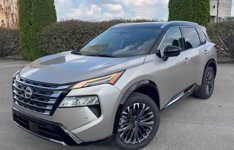
- Dark Armor trim is being introduced as a blacked-out styling package (gloss black accents, black wheels, badges, grille elements) likely based on the SV trim.
- The Rock Creek trim, already rugged-themed, is expected to see a price cut to increase its appeal.
- Some trim and package shuffling: the Premium package on SV might get replaced by a “Cold Weather package” (heated seats/steering wheel) while some technology or premium packages may be dropped in SL.
- Exterior styling tweaks, potentially more aggressive front/rear fascias or updated lighting, but core silhouette likely remains consistent with 2025/2024 design.
Performance & Range Enhancements
- The base internal combustion engine (ICE) remains the 1.5 L VC-Turbo inline 3-cylinder with ~201 hp and 225 lb-ft torque.
- Efficiency targets for FWD trims: ~29 mpg city / 36 mpg highway.
- With AWD, fuel economy expected to drop slightly (e.g. ~28 mpg city, 35 mpg highway) due to drivetrain losses.
- PHEV variant: combining a 2.4 L engine + electric motors, for ~248 hp combined output, with an estimated pure-electric range (e.g. 20–40 miles, depending on battery).
- The CVT (Xtronic) remains, possibly tuned for smoother transitions or better efficiency.
- Driving modes like Eco, Sport, Off-Road / Snow (in AWD models) are expected to remain or be refined.
Battery Life & Charging (for PHEV)
- The PHEV will have a battery pack enough to yield a modest electric-only range (exact figure not yet confirmed).
- Charging: likely support for Level 2 (AC) charging; fast DC charging capacity and speed are unknown at this time.
- Hybrid and EV efficiency gains may help lower emissions and fuel usage on shorter commutes.
Acceleration & Handling
- Acceleration should be strong for its class, aided by the turbo engine and CVT.
- In PHEV mode, instantaneous electric torque may improve low-end response.
- Suspension tuning, chassis stiffening, and driver assist calibration may be refined for better ride comfort and handling balance.
- AWD versions may receive tweaks to traction control, especially in slippery conditions.
Safety & Driver Assistance
Safety Features (Expected / Confirmed)
- Nissan Safety Shield 360 remains standard: includes features like automatic emergency braking with pedestrian detection, blind-spot warning, rear cross-traffic alert, lane departure warning, high beam assist, and more.
- ProPILOT Assist 2.1: enhanced driver-assist for hands-free single-lane highway driving, object detection improvements, possibly standard or optional on higher trims.
- Advanced parking aids, 360° camera systems, parking sensors, and possibly automated parking features may be expanded in higher trims.
- Safety package adjustments: certain optional packages may be removed or restructured across trims.
Crash-Test Ratings & Awards (2025 as benchmark)
- In IIHS, 2025 Rogue has Good ratings in many crashworthiness categories.
- However, in 2025, front crash prevention (pedestrian) in some test conditions got Marginal / Poor depending on configuration.
- Safety is a selling point for Rogue in general; the 2026 model will aim to maintain or improve those ratings.
Interior, Comfort & Technology Updates
Infotainment & Connectivity
- A 12.3″ touchscreen display is already available; expect refinements in UI, speed, responsiveness, and possibly more features in mid or base trims.
- Higher trims may continue to include Google built-in (Maps, Assistant, etc.) or similar integrated services.
- Wireless Apple CarPlay / Android Auto, multiple USB-C ports, improved connectivity and app integration.
- Digital instrument cluster, head-up display (HUD) or augmented displays may be further improved or expanded.
Space, Cargo & Comfort
- Seating for 5, with 60/40 split-folding rear seats.
- Increased or optimized cargo capacity, with flexible load floor or “Divide-N-Hide” system (already present in some variants) likely continued in 2026.
- Materials and upholstery improvements: more premium or eco-friendly materials, better trim finishes, noise insulation, etc.
- Comfort upgrades: heated and ventilated front seats, heated steering wheel (especially via new cold-weather package), dual-zone climate control, improved seat ergonomics (Zero Gravity seats are mentioned).
Sustainability & Environmental Impact
- The PHEV variant helps reduce tailpipe emissions in electric-only driving zones or short commute scenarios.
- Use of more eco-conscious materials in interior trim, carpets, or seat fabric may be part of the update (as is trend in many automakers).
- Improved fuel efficiency in ICE and hybrid operation will reduce overall energy consumption and CO₂ output per mile.
Comparing to Previous (2025) / Competitors
- The 2026 Rogue aims to deliver better value (via price cuts), which may help it better compete with segment rivals like the Honda CR-V, Toyota RAV4, Mazda CX-5, etc.
- Performance, styling, and tech improvements (especially around infotainment and driver assist) will be key to staying competitive.
- The PHEV variant may make it more appealing vs. hybrid or plug-in offerings from rival brands.
Customer Reviews, Feedback & Owner Sentiment
- Likes: strong interior comfort, good feature content for the price, competitive performance for the class, and stylish new trim options.
- Criticisms: perhaps the limited electric-only range (in PHEV), possible compromises in power compared to some rivals, and CVT behavior under hard acceleration.
- Some users may feel certain optional features (packages) are too expensive or insufficiently modular.
Availability & Pricing
- Expected Starting Price (MSRP): For the 2026 Rogue S (base) in the U.S., around $28,790 (including destination) per Edmunds.
- Higher trims (SV, SL, Rock Creek, Platinum, AWD variants) will progressively cost more — e.g. the Rock Creek AWD is listed around $33,690 in current data.
- The price drop pertains especially to the Rock Creek trim — insiders say it will be more aggressively priced in 2026.
- Dealers may open up reservations or pre-orders ahead of full launch. Final pricing, incentives, and region-specific options will affect the local cost.
Questions & Answers (Based on What’s Known So Far)
Q: What are the performance and range enhancements for 2026?A: The base ICE remains 1.5 L turbo with ~201 hp / 225 lb-ft torque. Fuel economy for FWD is expected around 29/36 mpg. A new PHEV variant adds electric capability plus ~248 hp combined and moderate EV range.
Q: What safety features does the 2026 Rogue include?
A: Standard Safety Shield 360 (emergency braking, blind-spot, cross-traffic, lane departure, high-beam assist). ProPILOT Assist 2.1 is expected or available, plus parking aids, cameras, etc.
Q: What are the interior updates and technology features?
A: 12.3″ touchscreen, Google built-in, wireless Apple CarPlay / Android Auto, multiple USB-C ports, improved UI, better materials, enhanced comfort features (heated seats, better insulation).
Q: How much will it cost?
A: About $28,790 MSRP for the base Rogue S (U.S. market) including destination.Trim and options will push prices higher.
Last edited:


