

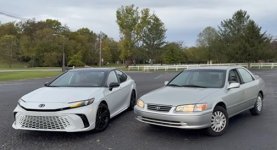
2000 Toyota Camry vs. 2025 Camry: Here’s What’s Better, Worse & Will Never Change! (25 Years Later)
Back in 2000, the Toyota Camry was already known as the car that would never die. It was quiet, comfortable, practical, and bulletproof.
Fast-forward to 2025, and the Camry has transformed into a sleek, hybrid-powered sedan that blends performance, efficiency, and technology without losing its dependable DNA.
Let’s see what’s better, what’s worse, and what will never change after 25 years of evolution.
Better: Aerodynamics, modern styling, larger stance.
Worse: Harder to repair after minor fender benders, costlier parts.
Never changed: A design focused on comfort and visibility over pure sport.
 Better:
Worse: Touchscreen controls can distract while driving.
Never changed: Ergonomic layout, practical storage, and long-distance comfort.
Worse: Complex sensors can be costly to repair after an accident.
Never changed: Safety remains Toyota’s top priority.
Better: Handling, stability, noise reduction.
Worse: Less mechanical simplicity — no more DIY tune-ups.
Never changed: It’s still the family sedan that makes every trip easy.
Toyota’s reputation for durability was built on cars like the 2000 Camry — many are still running today with 300,000 + miles.
The 2025 model continues that legacy with hybrid systems proven in millions of Toyota and Lexus vehicles. The difference is complexity — fewer home mechanics will be able to do their own maintenance.
Better: Longer service intervals, better corrosion protection.
Worse: Costlier electronic repairs, battery replacement down the line.
Never changed: Exceptional long-term reliability and resale value.
Even adjusted for inflation, the 2025 Camry offers far more technology, efficiency, and safety for nearly the same real cost — a testament to Toyota’s steady value proposition.
Better: More car for the money.
Worse: Higher cost to maintain long-term.
Never changed: Still one of the smartest family sedans for the money.
The 2000 Camry represented a simpler time — when reliability was the only technology you needed. The 2025 Camry represents progress — when eco-efficiency, safety, and digital comfort define modern motoring.
If you loved the old Camry’s quiet confidence, the new one keeps that DNA alive — only now it’s smarter, safer, and greener.
After 25 years, the Camry remains what it has always been: reliable, practical, and quietly excellent.
The 2000 model is nostalgia on wheels — simple, honest, and unbreakable.
The 2025 model is the evolution of that spirit — refined, efficient, and future-ready.
Whichever generation you prefer, one thing is certain: a Camry will always just work.
Introduction: From Reliable Workhorse to Tech-Loaded Icon
Back in 2000, the Toyota Camry was already known as the car that would never die. It was quiet, comfortable, practical, and bulletproof.
Fast-forward to 2025, and the Camry has transformed into a sleek, hybrid-powered sedan that blends performance, efficiency, and technology without losing its dependable DNA.
Let’s see what’s better, what’s worse, and what will never change after 25 years of evolution.
1. Design Evolution: From Conservative to Confident
- 2000 Camry:
The 2000 Camry (XV20 generation) was the definition of understated. Smooth, rounded edges, a simple grille, and small headlights. It was built to blend in, not stand out.
Dimensions: 188.5 in long, 70.1 in wide, and around 3,000 lb curb weight. - 2025 Camry:
The new 2025 Camry looks nothing like its ancestors. With bold LED lighting, sculpted bodywork, and aggressive front fascia inspired by Lexus design language, it finally looks like it drives fast.
Dimensions: 193 in long, 72.4 in wide, around 3,500 lb curb weight.
Better: Aerodynamics, modern styling, larger stance.
Worse: Harder to repair after minor fender benders, costlier parts.
Never changed: A design focused on comfort and visibility over pure sport.
2. Powertrain & Performance: Gas vs. Hybrid Power
- 2000 Camry engines:
- 2.2-liter 4-cylinder: ~133 hp
- 3.0-liter V6: ~194 hp
Transmission: 4-speed automatic or 5-speed manual.
- 2025 Camry engines:
- 2.5-liter 4-cylinder hybrid (standard): 225 hp FWD or 232 hp AWD
- Transmission: e-CVT hybrid system, smooth and quiet.
Better:- Fuel economy: Up to 51 mpg city / 53 mpg highway for the 2025 hybrid.
- Quicker acceleration (0–60 mph in about 7 seconds vs 9.5 seconds for 2000).
Worse: No more V6 option — enthusiasts miss the old silky power.
Never changed: Quiet, refined ride with smooth power delivery and reliability first.
3. Interior & Comfort: From Cloth Seats to Digital Lounge
- 2000 Camry cabin:
Soft cloth, analog gauges, and a cassette/CD player. Basic but functional.
Rear legroom: 36.7 in, trunk space: ~14.1 cu ft. - 2025 Camry interior:
The new Camry feels like a mini-Lexus. Dual screens (up to 12.3″ each), ambient lighting, wireless Apple CarPlay & Android Auto, and available panoramic glass roof.
Rear legroom: 38 in, trunk: 15.1 cu ft.
Worse: Touchscreen controls can distract while driving.
Never changed: Ergonomic layout, practical storage, and long-distance comfort.
4. Safety & Technology: From Basic to Brilliant
- 2000 Camry:
Safety was modest — dual front airbags, anti-lock brakes, and optional traction control.
No blind-spot monitoring, lane assist, or stability control as standard. - 2025 Camry:
Every model comes with Toyota Safety Sense 3.0:- Adaptive cruise control
- Lane-keeping assist
- Automatic emergency braking
- Road-sign recognition
- Pedestrian detection
- Plus optional 360° camera, rear cross-traffic alert, and auto-parking.
Worse: Complex sensors can be costly to repair after an accident.
Never changed: Safety remains Toyota’s top priority.
5. Driving Experience: Comfort Then, Confidence Now
- 2000 Camry:
Soft suspension, almost no steering feel — but it floated down the road effortlessly.
Perfect for comfort, not excitement. - 2025 Camry:
Hybrid power delivers smooth torque, AWD available for the first time, and the chassis is stiffer with better handling balance.
The ride still prioritizes comfort, but it’s much more composed at highway speeds.
Better: Handling, stability, noise reduction.
Worse: Less mechanical simplicity — no more DIY tune-ups.
Never changed: It’s still the family sedan that makes every trip easy.
6. Reliability & Maintenance: The Unshakable Camry Legacy
Toyota’s reputation for durability was built on cars like the 2000 Camry — many are still running today with 300,000 + miles.
The 2025 model continues that legacy with hybrid systems proven in millions of Toyota and Lexus vehicles. The difference is complexity — fewer home mechanics will be able to do their own maintenance.
Better: Longer service intervals, better corrosion protection.
Worse: Costlier electronic repairs, battery replacement down the line.
Never changed: Exceptional long-term reliability and resale value.
7. Pricing & Value: Then vs. Now
- 2000 Camry: Base price around $18,000 USD (roughly $33,000 in today’s money).
- 2025 Camry: Starting around $28,400, top trims reach $38,000+.
Even adjusted for inflation, the 2025 Camry offers far more technology, efficiency, and safety for nearly the same real cost — a testament to Toyota’s steady value proposition.
Better: More car for the money.
Worse: Higher cost to maintain long-term.
Never changed: Still one of the smartest family sedans for the money.
8. Verdict: 25 Years Later, the Spirit Lives On
The 2000 Camry represented a simpler time — when reliability was the only technology you needed. The 2025 Camry represents progress — when eco-efficiency, safety, and digital comfort define modern motoring.
If you loved the old Camry’s quiet confidence, the new one keeps that DNA alive — only now it’s smarter, safer, and greener.
Quick Comparison Table
| Feature | 2000 Camry | 2025 Camry |
|---|---|---|
| Engine | 2.2L I4 / 3.0L V6 | 2.5L Hybrid I4 |
| Power | 133 – 194 hp | 225 – 232 hp |
| Transmission | 4-speed auto / 5-manual | e-CVT automatic |
| Drivetrain | FWD | FWD or AWD |
| MPG (combined) | ~24 mpg | ~51 mpg |
| Airbags | 2 | 10+ with ADAS |
| Infotainment | CD/Cassette | 12.3″ Touchscreen |
| Price (base) | $18,000 | $28,400 |
| Legacy | Durable, simple | Efficient, tech-savvy |
Final Thoughts
After 25 years, the Camry remains what it has always been: reliable, practical, and quietly excellent.
The 2000 model is nostalgia on wheels — simple, honest, and unbreakable.
The 2025 model is the evolution of that spirit — refined, efficient, and future-ready.
Whichever generation you prefer, one thing is certain: a Camry will always just work.