

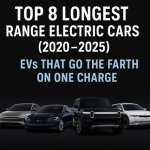
Are we finally done with range anxiety? I've curated a list of 8 EVs from 2020–2025 that prove just how far battery tech has come. From luxury sedans to heavy-duty trucks, these models are setting the new gold standard for a single charge.
Top 8 Long-Range EVs (2020-2025) and Energy Consumption
| # | Model (Year) | EPA-Rated Range* | Energy Consumption / Efficiency | Notes |
|---|---|---|---|---|
| 1 | Lucid Air (2025) | 512 miles (824 km) | Very efficient: example figure 26 kWh/100 mi for some variants. | Top-end luxury sedan; sets benchmark for range. |
| 2 | Lucid Gravity (upcoming/2025+) | 450 miles (725 km) | Still premium; the SUV variation of the brand. | High range in three-row / SUV form. |
| 3 | Tesla Model S (2024) | 402 miles for LR-AWD (19-in wheels) | Consumption 276 Wh/mi ( 3.6 mi/kWh) for that version. | A long-range pioneer; still very competitive. |
| 4 | Rivian R1T (2024-25) | Up to 420 miles (676 km) in Dual Max battery configuration | As a pickup/truck form factor, impressive range. | Utility meets long-range EV. |
| 5 | Chevrolet Silverado EV (2025) | 493 miles (794 km) claimed in some Max Range spec | Large vehicle, very big battery pack. | Large truck segment, long-range capability. |
| 6 | Mercedes‑Benz EQS (2025) | 390 miles (628 km) estimated | Luxury EV sedan from Mercedes. | Adds prestige + long range. |
| 7 | Hyundai IONIQ 6 (2025) | 342 miles (550 km) for SE RWD version | More accessible price point, still long range. | Value + range combination. |
| 8 | Kia EV6 (2025) | 319 miles (513 km) for RWD version | Stylish crossover/e-crossover form. | Good blend of practicality & range. |
Ranges are EPA estimates or widely reported manufacturer/third-party figures; actual real-world range will vary with speed, weather, usage, wheel size, etc.
What these numbers tell us
Models at the very top (Lucid Air, Lucid Gravity, Silverado EV) are pushing well beyond 400 miles (640 km) on a single charge which is well above the 250-300 mile (≈400-500 km) threshold many buyers consider sufficient.Energy consumption (i.e., how many kWh the vehicle uses per 100 miles or how many miles per kWh) is a key hidden factor. For example, the Model S LR shows 276 Wh/mi (~3.6 mi/kWh) for one configuration.
Even more affordable EVs (Hyundai IONIQ 6, Kia EV6) are closing the gap, offering over 300 miles of range in mainstream models.
Range figures are still heavily dependent on conditions: driving style, wheel size, aerodynamics, temperature, elevation, and load all influence actual range. Real-world tests sometimes show 5-23% less than advertised.
Why this matters for U.S. buyers
Since many U.S. buyers ask “How far can I go on a single charge?”, this list is meaningful:
If your daily drive is moderate and you have access to home charging, 300+ mile range already covers almost all typical usage.
For frequent long trips, or fewer charging stops, the 400+ mile class vehicles offer a compelling advantage.
Choosing a vehicle with lower consumption means less wasted energy, better efficiency which translates to better real-world range and lower cost per mile.
Some highlights worth noting
Lucid Air’s claim of 512 miles sets a strong benchmark.Tesla Model S remains very efficient and long-range despite being an older platform relative to newest launches.
The Silverado EV demonstrates that even large trucks can now approach the long-range territory once reserved for luxury sedans.
Vehicles with better efficiency can achieve more practical range even if battery size isn’t as massive showing that powertrain and aerodynamics still matter a lot.
For practical purchase decisions: if you find an EV that offers 250-300 miles range at an accessible price, that may already satisfy most driving use-cases; going above that is “extra range comfort.”
Last edited: