

Jeep Wrangler 4xe vs. Jeep Grand Cherokee 4xe covering specs, real-world range & fuel consumption, charging, likely maintenance costs (as best as publicly known), plus some “real-life” pros & cons. I also sprinkled in “infographic-style” visuals (graphs & tables) so you get a clear side-by-side. Finally at the end I invite you (and other readers) to weigh in 
Visuals — the cars up close
Jeep Wrangler 4xe vs Jeep Grand Cherokee 4xe
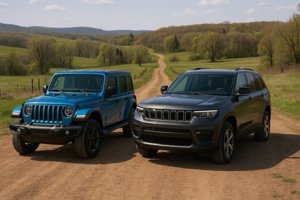
Spec & Features Comparison: Wrangler 4xe vs Grand Cherokee 4xe
| Specification / Feature | Wrangler 4xe | Grand Cherokee 4xe |
|---|---|---|
| Powertrain | 2.0L turbo I4 + electric motors (PHEV) | Same 2.0L turbo I4 + electrics (PHEV) |
| Combined Power / Torque | 375 hp, 470 lb-ft torque | 375 hp, 470 lb-ft torque |
| Drivetrain / Transmission | Full-time 4×4 (Selec-Trac or Rock-Trac), 8-speed auto | 4×4 (Quadra-Trac II / optional Quadra-Drive II), 8-speed auto |
| Electric-only range (factory / EPA) | ~ 21 miles (≈ 33–34 km) per EPA / PHEV spec. | ~ 25–26 miles (≈ 40–42 km) per EPA / PHEV spec. |
| Combined (gas + battery) maximum range | ~ 370 miles (≈ 595 km) per some PHEV specs. | ~ 470 miles (≈ 755 km) per some PHEV specs. |
| Fuel economy (equivalent) | ~ 49 MPGe combined (city/highway electric + hybrid) | ~ 56 MPGe combined |
| WLTP / European (for Grand Cherokee 4xe) | — | 2.6–3.0 l/100 km (combined), CO₂ 61–69 g/km |
| Battery / Charging | 17 kWh battery; 7.2 kW onboard charger; full charge about 2 hours on 240 V (Level 2) or ~12h on standard outlet. | Similarly: 14 kWh (or usable battery spec) battery; 7.2 kW charger; ~2–2.5 h on 240 V, ~8–15 h on standard outlet. |
| Interior & Comfort | Off-road-focused: waterproof / washable interior, removable doors/tops, simpler trim (but 12.3" Uconnect screen, leather seats possible) | More “soft-road / family SUV” comfort: power-adjustable seats (12-way), optional luxury extras, roomy interior, more conventional SUV feel. |
| Towing Capacity | Up to ~ 3,500 lbs (~1,588 kg) towing capacity. | Up to ~ 6,000 lbs (~2,722 kg) towing capacity. |
| Off-road / Utility-oriented features | Removable doors and roof, washable interior, rugged frame, good for real trails/ mud/ water, heritage Jeep-style. | Still capable 4×4 and off-road features — but more tuned toward comfort + versatility (less “bare bones” than Wrangler). |
Real-World Range, Fuel Consumption & Charging — What You Actually Get
Electric-Only Range & Daily Usability
- Grand Cherokee 4xe: ~ 25–26 miles (≈ 40–42 km) on electric only.
- Wrangler 4xe: ~ 21 miles (≈ 33–34 km) on electric only.
What that means in practice: If you commute 30-40 km/day, the Grand Cherokee 4xe might do your daily driving on pure electric zero gas while Wrangler 4xe gets you a decent chunk, but maybe not quite enough to avoid the petrol engine entirely.
Combined Range (Gas + Battery) — The “Road-Trip” Potential
- Wrangler 4xe: ~ 370 miles (~595 km) total range.
- Grand Cherokee 4xe: ~ 470 miles (~755 km) total range.
Fuel Efficiency (Hybrid / Combined)
- Wrangler 4xe: ~ 49 MPGe (electric + hybrid combined).
- Grand Cherokee 4xe: ~ 56 MPGe (combined). lakekeoweechryslerdodge.com
- European WLTP numbers for Grand Cherokee 4xe: ~ 2.6–3.0 l/100 km (combined) + 61–69 g CO₂/km. jeep.hu+1
Conclusion: Grand Cherokee 4xe is a bit more efficient in “ideal circumstances” — and because of bigger battery / range, it might give you a more realistic fuel saving if you plug in regularly.
Charging Time & Practical Charging
- Both: 7.2 kW onboard charger. jeep.ca+2Car and Driver+2
- On a standard household outlet (120 V / 230 V depending on region): ~ 12 hours (Wrangler) or 8–15 hours (Grand Cherokee) for full charge. woodhousechryslerjeepdodge.com
- On a 240 V (Level 2) charger: ~ 2–2.5 hours to full.
 Meaning for you: Overnight at home is fine with either. If you have a Level 2 charger boom you’re charged in a couple of hours, ready for the next day.
Maintenance, Running Costs & Real-World Considerations (the “less sexy but very real” stuff)
- Both 4xe models share much of the same hybrid powertrain architecture (battery, electric motors + ICE + 8-speed auto). 4xeforums.com
- Running costs in hybrid mode (especially when you mostly drive electric for daily commuting) should be notably lower than a conventional petrol/diesel Jeep — lower fuel bills, fewer “gas fill-ups.”
- On the Wrangler 4xe, manufacturers claim ~ 3.5–4.1 l/100 km under WLTP when using hybrid (gas + electric) mode. jeep.com
However public data on long-term maintenance costs (battery degradation, hybrid-system servicing, repairs) for both models is still limited. Why? Because plug-in hybrids are relatively new in the mass market and long-term ownership data is still scarce.
From what we know:
- Because the powertrain (engine + motors + battery + 8-speed auto) is quite complex vs a simple petrol engine — maintenance and repair costs could be higher (especially if battery issues or electronics problems arise).
- On the flip side: fewer fuel stops, less engine wear if mostly used in electric/hybrid mode which might offset some maintenance by reducing stress on the ICE.
- For off-roaders (especially Wrangler), rough terrain, water-fording, removable doors/roof etc. could mean more wear on body, seals, mechanicals depending on how adventurous you get.
Which One Suits You — “Use-Case” Style
- If you want a rugged, iconic Jeep vibe, love off-road, trails, mud, maybe want to remove doors/roof, enjoy that classic Jeep-freedom go for Wrangler 4xe. It’s the wild child: less “luxury,” more “adventure.”
- If you want a comfortable SUV for everyday driving, family trips, better range, more comfort, perhaps towing, and are okay with a slightly softer Jeep-vibe Grand Cherokee 4xe is the adult, responsible-but-still-Jeep choice.
In short: Wrangler 4xe is “Jeep-in-your-soul,” Grand Cherokee 4xe is “Jeep-in-your-garage + family-ready.”
Infographic-Style Quick Stats (Graphical Summary)
insideevs.com
The “Human (Slightly Funny) Reality Check”
Wrangler 4xe: “Hey buddy, I’m your weekend warrior mud, forest, open top, and that wind-in-your-hair feeling. I don’t care much for leather-sofas or fancy seat-massage give me a winch, good tires, and a dusty back-road.”
Grand Cherokee 4xe: “Alright, I’m your comfy, sensible buddy. I’ll drive the kids to school, haul your bike rack, tow your trailer, and still whisper quietly when you pull into the city with a full battery and zero exhaust smell. But if you try to remove my doors … I might protest softly.”
In other words: Wrangler 4xe is the rough-and-ready adventurer; Grand Cherokee 4xe is the civilized Jeep that wears jeans instead of camo.
My Take: Which One I’d Pick (If I Were You) and Why
- More electric range → daily driving on EV mode is realistic
- Larger total range + comfort → good for longer trips without frequent gas stops
- SUV-style practicality (space, towing) + hybrid efficiency
But if I were a weekend off-road junkie, love nature, adventure, and don’t care much about interior luxury I’d choose Wrangler 4xe without hesitation.
What About You — Speak Up!
Now I want to hear from you (and anyone reading this).
- Which one do you prefer Wrangler 4xe or Grand Cherokee 4xe and why?
- If you drive one (or know someone who does): what’s your real-world electric range / fuel use / charging / maintenance experience?
- What’s more important for you: “Jeep-spirit & adventure” or “comfort & practicality”?
Jump in, argue, comment let’s hear all angles.