

The 5 Most Reliable German EVs (2020–2025) — Prices, Common Issues & Head-to-Head Comparison
If you’re shopping used or nearly new, the 2020–2025 window is the sweet spot for German electric cars: batteries have matured, software has improved, and prices have softened. Below are five models with the strongest real-world reliability signals, plus what they typically cost today in Europe and the issues you should check before buying.
Why trust this list? ADAC’s nationwide roadside-assistance data shows EVs break down less often than same-age ICE cars; BMW’s i3 repeatedly tops the EV reliability charts.
1) BMW i3 (2020–2022)
Why it’s here: The i3 is a proven design that aged gracefully. Late-run cars (120Ah battery) are especially robust and benefit from years of incremental fixes. ADAC’s rankings consistently place it among the most dependable small EVs.
Typical EU prices (2025): ~€17,000–€28,000 depending on mileage and spec.
Common issues to check
- Early-build EME inverter module recalls (mostly pre-2020; verify campaign history).
- 12V battery age and charger health (like any EV, a weak 12V causes odd warnings). (General EV context via ADAC data.)
2) BMW i4 (2021–present)
Why it’s here: Classic BMW road manners, strong efficiency, and relatively clean reliability record among premium German EV sedans.
Typical EU prices: ~€25,000–€50,000+ depending on eDrive40 vs. M50 and mileage.
Common issues to check
- Isolated battery-module / HV software recalls on limited VIN ranges (ensure campaigns closed).
3) Mercedes-Benz EQA (2021–present)
Why it’s here: Compact premium crossover with a calm ride and generally solid reliability; later software builds smoothed early glitches.
Typical EU prices: ~€30,000–€40,000 for 2021–2023 EQA 250s with average mileage.
Common issues to check
- Battery-related recall activity noted for EQA/EQB (2021–2024) in specific cell batches; confirm VIN status.
Buyer tip: Verify SOH (state of health) with a dealer printout and that all battery/BMS updates are applied.
4) Audi Q4 e-tron (2021–present)
Why it’s here: The MEB-based Q4 combines a practical cabin with stable range and widespread service coverage; resale prices have become buyer-friendly. autoscout24.com
Typical EU prices: ~€23,000–€35,000+ depending on battery and quattro spec.
Common issues to check
- On-board charger (OCDC) failures prompting a 2025 recall for some 2024–2025 cars; verify 12V charging/drive power recall status.
5) Volkswagen ID.3 (2020–present)
Why it’s here: After rocky launch software, the ID.3 matured into a reliable, efficient compact with plentiful parts and service options. ADAC’s latest figures show strong improvement.
Typical EU prices: Wide spread; early 2021 cars can be found well under typical new-car money, later facelift cars higher. (UK examples dip into low-teens £; EU dealer networks list everything from budget early cars to near-new.)
Common issues to check
- Early infotainment/black-screen bugs (2020–2021) largely fixed by software updates; confirm current version and any related recalls.
Buyer tip: Prefer cars updated to ID.Software 3.x (or newer) with documented dealer history.
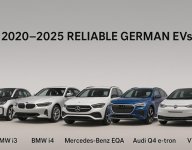
Head-to-Head: Reliability, Costs & Gotchas (2020–2025)
| Model | Reliability signal (public data) | Typical EU used price (2025) | Notable issues to check |
|---|---|---|---|
| BMW i3 | Consistently top of ADAC EV charts for small cars | ~€17k–€28k | Old EME recall closed? Healthy 12V? |
| BMW i4 | Generally strong; limited battery-module/software recalls on specific VINs | ~€25k–€50k+ | Recall status for HV battery/software; tire wear on M50 |
| Mercedes EQA | Stable after updates; scattered battery recall campaigns in certain batches | ~€30k–€40k | VIN check for battery/BMS campaigns |
| Audi Q4 e-tron | Solid daily reliability; 2025 charger/12V recall on some late cars | ~€23k–€35k+ | OCDC/12V recall addressed, latest software applied |
| VW ID.3 | Big improvement since launch; good recent ADAC scores | broad, from budget early cars to near-new | Early infotainment glitches fixed? Camera/speedo software updates done? |
EVs as a group: ADAC’s 2025 report shows EVs averaged 4.2 breakdowns/1,000 vehicles for 2020–2022 registrations vs 10.4/1,000 for ICE — with 12V battery still the #1 culprit across all powertrains.
What We Didn’t Include (and Why)
- Porsche Taycan (2020–) is fantastic to drive, but high-profile HV battery recalls (ARB6/ARB7) and early power-loss issues keep it off a “most reliable” shortlist for cost-conscious buyers in 2020–2025 stock. If you want one, buy post-fix and confirm diagnostics/charging limits were removed.
- Audi e-tron / Q8 e-tron (2019–): excellent comfort, but older e-trons can have cooling and charging quirks; late Q8 e-tron improvements narrow the gap.
How to Pick the Right One (Fast Checklist)
- Run a VIN recall check (brand portal) and confirm all software campaigns done — this matters more than trim.
- Check 12V battery test printout; many “EV failures” are really 12V issues.
- Battery SOH: ask for a dealer/independent report (DEKRA, etc.) and compare against mileage.
- Drive it: verify fast-charge behavior (no throttling) and infotainment stability after a full sleep/wake cycle.
- Total cost: price the tires/brakes/insurance; sporty trims (i4 M50, big-wheel Q4) raise running costs.
Bottom Line
- If you want bulletproof simplicity and low running costs: BMW i3 (late 120Ah) is still the dependable urban hero.
- For one car to do it all with premium polish: BMW i4 eDrive40.
- Prefer a compact premium crossover: Mercedes EQA or Audi Q4 e-tron — both strong after updates; just verify recall status.
- Need value and availability: a post-update VW ID.3 is a smart buy at current used prices.