

Overview: Xiaomi SU7 vs Tesla Model S – two very different EV strategies
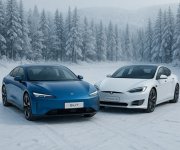
Xiaomi SU7
- The SU7 is currently not sold in the United States there is no official import or dealer network for U.S. buyers. Green Cars
- Because of trade/regulatory and homologation barriers, if you want an SU7 in the U.S., you’d likely need to rely on private import / grey-market routes, which comes with high risk and cost. Several automotive-site comparisons explicitly list “Market Availability: for the SU7 in the U.S.
Tesla Model S
- The Model S is widely available across the U.S., with official sales, service, and charging infrastructure (Supercharger network). Tesla
- As of 2025, the U.S. starting price for the Model S (Dual Motor AWD) is listed around US $84,990 after a recent price increase.
Bottom line (U.S. perspective): Tesla Model S is a real, readily available choice today. Xiaomi SU7 while interesting remains essentially unavailable unless you import privately (with all associated complications).
Price & Value (If SU7 were available in U.S.)
Because the SU7 isn’t officially sold in America, any “U.S. price” is hypothetical. But we can approximate based on Chinese retail prices and published import-style comparisons:
- In China, SU7 retail prices (2024 launch) start at ¥215,900 (standard) and go up to ¥299,900 (Max trim).
- That translates roughly to US $30,400 (standard) and US $42,200 (Max trim) — extremely aggressive compared to most American EVs.
- For its high-performance SU7 Ultra variant (2025), the FOB / export-market equivalent price has been cited around US $73,700 in some overseas listings. autoevolution
In comparison:
- The 2025 Tesla Model S starts around US $84,990 for Dual Motor AWD. Reuters
- The performance-oriented Plaid variant is more expensive (often well above $95–100 k depending on options).
Value verdict (theoretical U.S. import): If the SU7 could be bought/imported for near its Chinese pricing (or modestly inflated), it would represent a much lower-cost EV with performance comparable to premium models. That’s what makes SU7 a potential “disruptor” but only if you can actually buy it and solve parts, charging, homologation, etc.
Size, body style & practicality
- Xiaomi SU7 Max
- Body style: Sedan (4-door)
- Length ~ 196.7 in (about 4,997 mm), very similar to a large EV sedan.
- Cargo (trunk) volume: listed as ~ 17.4 cu ft; with a front trunk (frunk) ~ 3.7 cu ft.
- Because of the sedan configuration, cargo volume is less than a typical lift-back or hatchback design.
- Tesla Model S (Dual Motor / Plaid)
- Body style: Liftback (hatchback-style), which tends to increase practical cargo usability.
- Cargo: ~ 25 cu ft (rear) + front trunk.
- Folding rear seats can yield a large storage space, making it more versatile for luggage, shopping, road trips, etc.
Practicality verdict (U.S. use): The Model S is more practical and flexible for American driving habits road trips, larger cargo loads, varied usage (luggage, groceries, furniture, etc.). The SU7, as a sedan, is less cargo-versatile, which matters if you need space over pure performance.
Performance, range & charging (as reported for SU7 vs Model S)
Xiaomi SU7 (as built in China / export spec)
- SU7 uses an 800-volt electrical architecture (on higher trims), which allows faster DC charging.
- Performance numbers (for Max / Ultra trims): e.g., ~ 0–60 mph (or 0–100 km/h) is claimed extremely low (sub 3-second class for Max; sub-2s in Ultra).
- Battery capacity (as listed) slightly larger than Tesla’s (~ 100–106 kWh vs ~ 100 kWh), though “real-world efficiency” appears less favorable (higher kWh/100 mi).
Tesla Model S (U.S. spec)
- Dual Motor AWD: strong range according to 2025 testing, up to ~ 402 miles per charge on a full battery. Car and Driver
- Plaid variant: extreme performance 1.99 s 0–60 mph, 200 mph top speed (on track), 1,020 hp tri-motor setup. Tesla
- Charging: Supercharger network widely available in U.S.; DC fast-charging up to ~ 250 kW (V3 Superchargers).
Summary (Performance & charging): The SU7 on paper has top-class acceleration and an advanced charging architecture that may outpace Tesla in some raw metrics. However, in real-world U.S. use, the Model S benefits from a mature charging network, known reliability, and proven efficiency/range.
What works vs what doesn’t - For an American buyer
Why Model S is the safe real choice
- It’s readily available, certified, dealer-supported; no need to import or worry about homologation.
- Charging infrastructure (Superchargers) is robust and widespread across the U.S. no guesswork.
- Practicality and versatility: liftback + large cargo + proven reliability.
- Performance + range is already excellent and with Plaid, it remains one of the fastest EVs you can buy in the U.S. today.
Why SU7 - despite promise - is risky (for now)
- Not officially sold in the U.S.: no dealer network, no warranty support, no homologation for U.S. safety/ emissions regulations.
- After-sales, parts, support unknown: maintenance, service, crash repair, availability of parts would be uncertain or expensive.
- Charging infrastructure: Even if you import it, you’d rely on third-party fast-chargers compatible with CCS (if it supports that port); the seamless experience of Supercharger + Tesla nav/integration is lost.
- Resale value / legality is a gamble. Imports may have limited resale demand, and compliance with U.S. vehicle safety / crash / emissions / recertification regs could be problematic.
So… if you live in the U.S. - which should you pick (today)?
Given current market reality:
- If you want a real, usable EV today with warranty, reliable service, charging infrastructure, and resale value go for Tesla Model S.
- The Xiaomi SU7 remains an interesting “what-if” a high-performance, high-spec EV at a potentially much lower cost but for most Americans it remains theoretical. Unless you’re already planning a complex import and accept major trade-offs, it’s not a practical daily driver option today.
If you like I can project three scenarios for 2027–2030: what happens if Xiaomi successfully launches SU7 (or successor) in the U.S. and compare long-term ownership costs: import grey market vs official launch vs Tesla Model S ownership costs.
Do you want me to build that 2027–2030 forecast table for you now?