

The EV market in 2025 is no longer about who builds the best car it’s about who is playing the smartest long-term strategy.
And right now, Japan, Korea and China are playing completely different games.
As electric vehicles (EVs) become mainstream in 2025, one of the most common questions buyers ask is:
“Which EV brands are the most reliable Japanese, Korean, or Chinese?”
Each region has its strengths, weaknesses, and distinct engineering philosophies.
Below is a comprehensive, SEO-friendly comparison including real-world reliability, service network quality, value retention, battery warranties, and common problems you should know before buying an EV.
1. The Japanese EV Approach: Slow but Exceptionally Reliable
Representative Models (2025)
- Nissan Leaf / Ariya
- Toyota bZ4X / Lexus RZ
- Honda e:Ny1 / Prologue EV
Reliability
Japanese automakers have a long history of producing extremely reliable gasoline and hybrid vehicles and this reputation largely carries over into their EVs.
Japanese EVs prioritize:
- Long-term durability
- Conservative battery chemistry choices
- Proven components over experimental innovation
Service Network
Japan’s service infrastructure is one of the best in the world:
- Extensive dealer networks
- Highly trained technicians
- Fast parts availability
Resale Value
Japanese brands traditionally maintain the highest resale value of the three groups.
The Toyota bZ4X and Lexus EVs retain value well thanks to:
- Brand trust
- Conservative battery management
- Lower degradation rates
Battery Warranty
- 8 years / 160,000 km typical
- Very strict quality control
- Battery degradation is usually below average compared to others
Common Issues
- Slower DC fast-charging speeds than Korean or Chinese competitors
- Conservative range estimates
- Older models (Leaf) suffer from heat-related battery degradation due to lack of liquid cooling
- Limited cutting-edge tech compared to Korean and Chinese brands
Drivers who want long-term durability, simple design, and dependable servicing.
2. Korean EV Engineering: The Performance & Technology Leaders
Representative Models (2025)
- Hyundai Ioniq 5 / Ioniq 6
- Kia EV6 / EV9
- Genesis GV60 / GV70 Electrified
Reliability
Korean brands offer the perfect blend of:
- Strong reliability
- Advanced battery technology
- 800-volt ultra-fast charging systems
Service Network
Hyundai/Kia have rapidly expanded global EV service capacity:
- Wide dealer coverage
- Specialized EV tech training
- Strong warranty support
Resale Value
Korean EVs generally hold value well, especially:
- Kia EV6
- Hyundai Ioniq 5
- Genesis EV models
Battery Warranty
- 8 years / 160,000 km, often with better terms than competitors
- Very stable battery packs using proven LG Energy Solution and SK On cells
- Excellent thermal management systems
Common Issues
- Some models experienced early-production battery recall campaigns
- Software glitches (infotainment, cameras, ADAS) more common than Japanese brands
- Limited availability of parts in certain smaller markets
- Higher purchase price compared to Chinese brands
Drivers who want cutting-edge technology, long range, and the fastest charging.
3. Chinese EV Manufacturers: Innovation, Price Advantage & Rapid Growth
Representative Models (2025)
- BYD Atto 3 / Seal / Dolphin
- MG4 Electric
- XPeng G6 / P7i
- Nio ET5 / ES6
- Geely / Zeekr 001
Reliability
Chinese EVs have improved dramatically in the last 3–4 years.
Brands like BYD the world’s largest EV manufacturer use in-house batteries such as the Blade LFP, which is:
- Extremely safe
- Long-lasting
- Resistant to degradation
Service Network
This is where Chinese EVs differ:
- BYD & MG have expanding service networks in Europe
- XPeng, Nio, Zeekr: strong in China, limited elsewhere
Resale Value
Chinese EVs generally have the lowest resale value, because
- Rapid innovation makes models age quickly
- Brand recognition still developing outside China
- Market perception of Chinese build quality varies
Battery Warranty
- Typically 8 years / 150,000 km
- Many brands offer extended battery protection
- LFP batteries (BYD, MG) have longer cycle life and lower degradation
Common Issues
- Software instability (apps, infotainment, sensors)
- Variability in service quality depending on region
- Rapid model turnover lowers resale value
- Some early models had quality inconsistencies (fit & finish, calibration)
Buyers seeking maximum value, advanced features, and safe, long-life LFP batteries.
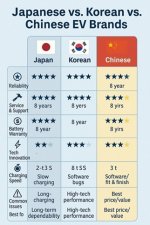
Head-to-Head Comparison Summary
| Category | Japanese EVs | Korean EVs | Chinese EVs |
|---|---|---|---|
| Reliability |  | | – |
| Service & Support | | | – |
| Resale Value | | | |
| Battery Warranty | 8 yrs | 8 yrs | 8 yrs |
| Tech Innovation | | | |
| Charging Speed | – | | |
| Common Issues | Slow charging | Software bugs | Software/fit & finish |
| Best For | Long-term dependability | High-tech performance | Best price/value |
Which Should You Choose?
✔ Choose Japanese EVs if you want:
- Maximum reliability
- Strong resale value
- A conservative, proven engineering approach
Choose Korean EVs if you want:
- Fast charging
- Long range
- High-tech features
- Great balance of quality + performance
Choose Chinese EVs if you want:
- The best price-to-performance ratio
- Modern tech and long-life LFP batteries
- Cutting-edge features at accessible prices
Conclusion: Each Region Has a Clear Advantage
- Japan = Reliability + long-term durability
- Korea = Leading battery tech + ultra-fast charging
- China = Innovation + unbeatable value
Last edited:
