

Japanese vs. Korean vs. Chinese EV Brands: Reliability, Service, Resale Value & Battery Warranty Compared (2025 Guide)
As electric vehicles (EVs) become mainstream in 2025, one of the most common questions buyers ask is:
“Which EV brands are the most reliable Japanese, Korean, or Chinese?”
Each region has its strengths, weaknesses, and distinct engineering philosophies.
Below is a comprehensive, SEO-friendly comparison including real-world reliability, service network quality, value retention, battery warranties, and common problems you should know before buying an EV.
1. The Japanese EV Approach: Slow but Exceptionally Reliable
Representative Models (2025)
- Nissan Leaf / Ariya
- Toyota bZ4X / Lexus RZ
- Honda e:Ny1 / Prologue EV
Reliability
Japanese automakers have a long history of producing extremely reliable gasoline and hybrid vehicles and this reputation largely carries over into their EVs.
Japanese EVs prioritize:
- Long-term durability
- Conservative battery chemistry choices
- Proven components over experimental innovation
Service Network
Japan’s service infrastructure is one of the best in the world:
- Extensive dealer networks
- Highly trained technicians
- Fast parts availability
Resale Value
Japanese brands traditionally maintain the highest resale value of the three groups.
The Toyota bZ4X and Lexus EVs retain value well thanks to:
- Brand trust
- Conservative battery management
- Lower degradation rates
Battery Warranty
- 8 years / 160,000 km typical
- Very strict quality control
- Battery degradation is usually below average compared to others
Common Issues
- Slower DC fast-charging speeds than Korean or Chinese competitors
- Conservative range estimates
- Older models (Leaf) suffer from heat-related battery degradation due to lack of liquid cooling
- Limited cutting-edge tech compared to Korean and Chinese brands
Drivers who want long-term durability, simple design, and dependable servicing.
2. Korean EV Engineering: The Performance & Technology Leaders
Representative Models (2025)
- Hyundai Ioniq 5 / Ioniq 6
- Kia EV6 / EV9
- Genesis GV60 / GV70 Electrified
Reliability
Korean brands offer the perfect blend of:
- Strong reliability
- Advanced battery technology
- 800-volt ultra-fast charging systems
Service Network
Hyundai/Kia have rapidly expanded global EV service capacity:
- Wide dealer coverage
- Specialized EV tech training
- Strong warranty support
Resale Value
Korean EVs generally hold value well, especially:
- Kia EV6
- Hyundai Ioniq 5
- Genesis EV models
Battery Warranty
- 8 years / 160,000 km, often with better terms than competitors
- Very stable battery packs using proven LG Energy Solution and SK On cells
- Excellent thermal management systems
Common Issues
- Some models experienced early-production battery recall campaigns
- Software glitches (infotainment, cameras, ADAS) more common than Japanese brands
- Limited availability of parts in certain smaller markets
- Higher purchase price compared to Chinese brands
Drivers who want cutting-edge technology, long range, and the fastest charging.
3. Chinese EV Manufacturers: Innovation, Price Advantage & Rapid Growth
Representative Models (2025)
- BYD Atto 3 / Seal / Dolphin
- MG4 Electric
- XPeng G6 / P7i
- Nio ET5 / ES6
- Geely / Zeekr 001
Reliability
Chinese EVs have improved dramatically in the last 3–4 years.
Brands like BYD the world’s largest EV manufacturer use in-house batteries such as the Blade LFP, which is:
- Extremely safe
- Long-lasting
- Resistant to degradation
Service Network
This is where Chinese EVs differ:
- BYD & MG have expanding service networks in Europe
- XPeng, Nio, Zeekr: strong in China, limited elsewhere
Resale Value
Chinese EVs generally have the lowest resale value, because:
- Rapid innovation makes models age quickly
- Brand recognition still developing outside China
- Market perception of Chinese build quality varies
Battery Warranty
- Typically 8 years / 150,000 km
- Many brands offer extended battery protection
- LFP batteries (BYD, MG) have longer cycle life and lower degradation
Common Issues
- Software instability (apps, infotainment, sensors)
- Variability in service quality depending on region
- Rapid model turnover lowers resale value
- Some early models had quality inconsistencies (fit & finish, calibration)
Buyers seeking maximum value, advanced features, and safe, long-life LFP batteries.
Head-to-Head Comparison Summary
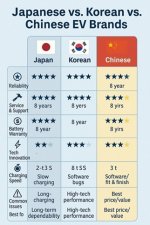
| Category | Japanese EVs | Korean EVs | Chinese EVs |
|---|---|---|---|
| Reliability |  | | – |
| Service & Support | | | – |
| Resale Value | | | |
| Battery Warranty | 8 yrs | 8 yrs | 8 yrs |
| Tech Innovation | | | |
| Charging Speed | – | | |
| Common Issues | Slow charging | Software bugs | Software/fit & finish |
| Best For | Long-term dependability | High-tech performance | Best price/value |
Which Should You Choose?
✔ Choose Japanese EVs if you want:
- Maximum reliability
- Strong resale value
- A conservative, proven engineering approach
Choose Korean EVs if you want:
- Fast charging
- Long range
- High-tech features
- Great balance of quality + performance
Choose Chinese EVs if you want:
- The best price-to-performance ratio
- Modern tech and long-life LFP batteries
- Cutting-edge features at accessible prices
Conclusion: Each Region Has a Clear Advantage
- Japan = Reliability + long-term durability
- Korea = Leading battery tech + ultra-fast charging
- China = Innovation + unbeatable value
As the global EV market matures, the differences narrow but understanding these strengths helps buyers choose the right EV for their needs in 2025.