

Hybrid Cars Are Winning America - Why 45% of U.S. Drivers Now Prefer Hybrids Over EVs (2025 Insight)
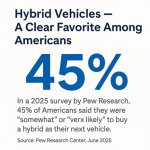
In 2025, a landmark survey by the Pew Research Center revealed a fascinating truth about the U.S. car market: nearly 45% of Americans say they are “very or somewhat likely” to buy a hybrid vehicle as their next car, while only about a third would seriously consider going fully electric.
This insight marks a turning point in the American electrification journey one where hybrid vehicles have become the pragmatic middle ground between traditional combustion and the full EV revolution.
The Pew Research Findings -What Americans Really Want
The Pew Research Center’s June 2025 report analyzed national consumer attitudes toward electric and hybrid cars. The data showed a clear hierarchy in consumer comfort levels:
- 45% are open to buying a hybrid.
- Only 33% say they’d consider a fully electric vehicle (EV).
- About 22% of respondents said they still plan to stick with gasoline cars for the foreseeable future.
Americans love the idea of electric cars but they love the reliability of gasoline and freedom from charging anxiety even more. Hybrids sit perfectly between these worlds.
Why Hybrid Vehicles Appeal to U.S. Drivers in 2025
The hybrid market has matured dramatically since Toyota first popularized it with the Prius decades ago. Today’s hybrids are sleek, quick, and technologically advanced offering the fuel savings and low emissions of an EV without the infrastructure headache.
Here are the key factors driving the hybrid boom:
1. Charging Anxiety Remains a Deal-Breaker
Even with growing investment, EV charging infrastructure in the U.S. is patchy outside major metro areas. Long road trips, rural commutes, and extreme-weather states (like North Dakota or Texas) still challenge pure EV ownership.
Hybrids, by contrast, can run anywhere they don’t depend on the next charging station.
2. Affordability and Incentives
The average price of an EV in the U.S. still hovers around $55,000, while the average hybrid is closer to $38,000.
That gap matters especially in 2025, when inflation and high financing rates still shape buyer decisions.
Many hybrids also qualify for partial federal tax credits or state-level green vehicle rebates, making them even more attractive.
3. Range and Flexibility
A typical hybrid can travel 500–600 miles on a full tank and a charged battery. That’s double or triple the real-world range of most EVs and it takes minutes to refuel instead of hours to recharge.
4. Proven Reliability
Hybrid systems have over 20 years of refinement behind them.
Models like the Toyota Prius, Honda Accord Hybrid, and Hyundai Tucson Hybrid consistently rank high in JD Power and Consumer Reports reliability surveys.
5. Transition Comfort
Many Americans see hybrids as a “training ground” for electrification an easy way to save fuel and lower emissions without changing habits overnight.
As one Pew survey respondent summarized: “A hybrid feels like the future, without giving up what I know.”
The Data Behind the Surge
Market data aligns with Pew’s consumer research. According to the U.S. Energy Information Administration (EIA), hybrid and plug-in hybrid models now make up about 22% of new vehicle sales in the second quarter of 2025 a record high.
Compare that with fully electric vehicles, which hover around 8–10% of sales nationwide, and the trend is clear: hybrids are mainstream, EVs are still aspirational.
Automakers have noticed, too.
- Toyota doubled its hybrid production capacity in North America.
- Ford reported stronger-than-expected sales of the Maverick Hybrid and Escape Hybrid.
- Even performance brands like BMW and Mercedes-Benz are expanding mild-hybrid and plug-in hybrid offerings to satisfy growing demand.
What Consumers Are Saying
The 2025 Pew survey also explored why Americans hesitate on full electrics. The top reasons include:
- “Not enough charging stations where I live.”
- “EVs are too expensive.”
- “I drive long distances too often.”
This attitude shift reflects a practical mindset. Americans don’t necessarily reject electrification; they’re simply waiting for the infrastructure and prices to catch up.
Environmental Impact and Policy Context
From a sustainability perspective, hybrids might not be as carbon-free as pure EVs but they make a measurable impact.
According to EPA data, a modern full hybrid can cut CO₂ emissions by 30–50% compared with a conventional gasoline car.
In many states, that’s enough to meet fleet-average emission targets without massive investment in charging networks.
It’s a realistic bridge technology, helping the U.S. reduce fuel consumption while the EV ecosystem matures.
Which Hybrids Are Americans Buying Most?
Based on 2025 sales and search data, the top-selling and most-Googled hybrid models in the U.S. include:
| Rank | Model | Type | EPA Combined MPG | Starting MSRP |
|---|---|---|---|---|
 | Toyota RAV4 Hybrid | Full Hybrid | 40 MPG | $31,725 |
 | Ford Maverick Hybrid | Full Hybrid | 37 MPG | $25,500 |
 | Honda CR-V Hybrid | Full Hybrid | 40 MPG | $34,050 |
 | Hyundai Tucson Hybrid | Full Hybrid | 38 MPG | $32,500 |
 | Toyota Prius | Full Hybrid | 52 MPG | $28,700 |
(Prices are approximate 2025 MSRPs; real-world mileage may vary.)
Each of these models delivers excellent fuel economy, long range, and established reliability exactly what risk-averse American consumers are looking for in uncertain economic times.
The Future: Will Hybrids Stay on Top?
EV sales are still growing, especially in urban areas and coastal states. But the hybrid’s resurgence in 2025 suggests the transition to full electrification will take longer than many predicted.
Several automakers are now rethinking “EV-only” timelines:
- Ford delayed its all-electric targets to maintain hybrid production through the late 2020s.
- Toyota continues to champion hybrids as “the practical step toward carbon neutrality.”
- GM has quietly resumed developing hybrid variants for future models after pausing in 2020.
In other words, the hybrid isn’t just a bridge it’s a destination for many drivers.
Key Takeaways
- 45% of Americans now prefer hybrids, according to Pew’s 2025 survey.
- Infrastructure anxiety and cost remain the biggest EV barriers.
- Hybrids offer instant convenience no plug, no waiting, just drive.
- Automakers are leaning back into hybrid strategy to meet real-world demand.
- The hybrid era isn’t ending it’s being reinvented as a smart, sustainable alternative.
Conclusion
The 2025 Pew Research data confirms what dealers, automakers, and consumers are already seeing:
America’s electrification story isn’t about abandoning gasoline overnight it’s about evolving intelligently.
For millions of drivers, hybrid vehicles represent that evolution a solution that balances eco-consciousness with real-world practicality.
Until charging networks catch up and EV prices drop further, hybrids will remain the most realistic choice for the American middle class efficient, affordable, and trusted.