

Ford F-150 Lightning vs Gas F-150: Road Trip & Commute Cost Compared
Why This Comparison Matters
The shift from internal combustion engine (ICE) trucks to electric trucks is more than eco-friendly branding. For many prospective buyers whether a road-trip lover, a commuter, or a work-truck user the real cost of driving is a huge factor. The F-150 Lightning promises “fuel” savings, but how dramatic are they? And under what conditions do they materialize?
The 8-hour road trip (say, 500 km / ~310 miles) or long daily commute is a good test case high-speed driving, probably highway, maybe some charging stops, and real-world efficiency.
How F-150 Lightning and F-150 Differ (Range, Efficiency, Fuel Type)
- According to the U.S. EPA quoted about the F-150 and F-150 Lightning: the gas F-150 offers roughly ~23 mpg (combined).
- The electric F-150 Lightning, with a full battery, delivers up to ~320 miles (≈ 515 km) of electric range (EPA estimated).
- One F-150 Lightning owner in a forum observed real-world highway efficiency around 2.1 miles/kWh when cruising on highways (vs higher mi/kWh in town).
These numbers matter when you calculate how much it costs in “fuel” (electricity vs gas) to cover a given distance.
What Does It Cost to Drive? - Typical Scenarios
F-150 Lightning “Fuel” (Electricity) Cost
- A recent article examined that a full recharge of the Lightning in a state with moderate electricity rates costs between ~ US$22.27 (Standard-Range) and ~US$29.77 (Extended Range).
- For longer trips: if you average ~2.5 mi/kWh (realistic mix of highway + slower driving) and electricity costs around US $0.14–0.18 / kWh (common average in many U.S. states), the per-mile “fuel” cost works out to roughly $0.05–$0.08 per mile. This aligns with broader EV-vs-gas comparisons: EVs often come out at $0.03–$0.06 per mile, while gas vehicles with average efficiency hit $0.12–$0.15 per mile.
- One reported real-world owner observation: about $0.04/mile for electricity vs $0.14/mile for gas for a comparable usage pattern.
So when charging at home or at a reasonably priced charger the Lightning tends to be substantially cheaper per mile than a gas truck.
— Gas F-150 Fuel Cost
- With ~20–23 mpg (depending on engine), and assuming gas price at, say, US $3.50–$4.50 per gallon (or whatever local/regional price may be), fuel cost per mile typically ends up around $0.13–$0.18/mile. Pickup Truck +SUV
- For an average driver covering, say, 15,000 miles per year, that adds up to a substantial fuel budget over time.
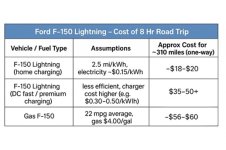
What About an 8-Hour Road Trip (≈ 300–320 Miles / ~500 km)?
Let’s run a hypothetical.
| Vehicle / Fuel Type | Assumptions | Approx Cost for ~310 miles (one-way) |
|---|---|---|
| F-150 Lightning (home charging) | 2.5 mi/kWh, electricity ~$0.15/kWh | ~$18–$20* |
| F-150 Lightning (DC fast / premium charging) | less efficient, charger cost higher (e.g. $0.30–0.50/kWh) | $35–$50+ |
| Gas F-150 | 22 mpg average, gas $4.00/gal | ~$56–$60 |
* Calculation: 310 miles ÷ 2.5 mi/kWh = 124 kWh → × $0.15/kWh ≈ $18.60
Interpretation: If you can charge at home (or a cheap charger) — and especially if you charge before the trip — the F-150 Lightning could cost less than half of the fuel expense of a gas F-150 for that 8-hour road-trip distance. Even if you rely on pricier DC fast charging, you might break even or still be somewhat cheaper.
Long-Term: Daily Commute or Frequent Distance Driving
- Using the numbers above, EVs enjoy a significant per-mile cost discount. As one EV-vs-gas cost comparison suggests, EV owners often pay ~$0.03–$0.06 per mile vs ~$0.12–$0.15 per mile for gas cars.
- Over many miles (commutes, routine driving, errands, occasional road trips), that adds up: one reported Lightning owner saved ~$1,500 per year, when driving ~12,000 miles annually, just on “fuel.”
- Over several years, these savings accumulate and EVs tend to have lower maintenance costs (fewer moving parts, no oil changes, etc.) which tilts total cost of ownership further in favor of EVs. NRDC+2EV
What to Watch Out For - When Savings Shrink
- Charging cost and location matter. If you rely heavily on public fast-chargers especially expensive ones your cost per mile can increase significantly, sometimes approaching or even exceeding gas-truck costs. Car and Driver
- Driving style & speed. Highway driving, heavy foot on the pedal, towing all these reduce miles/kWh, which raises per-mile cost. Real-world owner reports show that highway efficiency often drops to ~2.1 mi/kWh.
- Upfront costs & other expenses. EVs often have higher sticker price than comparable ICE trucks; also charging infrastructure (home charger installation, wiring, possibly higher electricity rates) can affect the overall savings. Maintenance costs are lower, but other expenses (insurance, depreciation, charging equipment) also factor in.
- For long road-trips with many miles and frequent fast-charging, the cost advantage shrinks depending on electricity cost, charger rates, and availability.
Real-World Relevance: When Lightning “Pays Off”
Great scenario for Lightning
- Daily commuting or moderate-distance driving — charging mostly at home or low-cost chargers.
- Owners who mostly drive urban or mixed-use miles (where EV efficiency tends to be better).
- Drivers who value lower “fuel” costs, fewer maintenance visits, and long-term savings.
- Occasional road trips, as long as one plans charging strategically (home or inexpensive chargers).
When the gas F-150 might make more sense
- Heavy highway driving, frequent long trips, or towing heavy loads (reduces EV efficiency).
- Lack of reliable home charging or access only to expensive public fast chargers.
- Upfront cost / depreciation concerns, or if total cost of ownership (not just fuel) matters more than “fuel savings.”
Want to Compare Yourself? Useful Tools & Resources
- Tool: Alternative Fuels Data Center (AFDC) has a “Vehicle Cost Calculator” that lets you estimate total cost of ownership depending on driving habits. afdc.energy.gov
- Article: “Electric vs. Gas Cars Is it Cheaper to Drive an EV?” by NRDC: overall shows EVs tend to cost much less to “fuel”. NRDC
- Real-world owner forum data on actual miles/kWh, electricity vs. gas cost helpful to calibrate expectations.
My Take: For Many - Lightning is a Smart Bet, With Conditions
If I were living in the U.S. and had stable access to reasonably priced home (or off-peak) electricity, and if my driving was a mix of commuting, errands, and occasional highway — I’d lean strongly toward the F-150 Lightning. The per-mile savings are real; over years, they pile up. For long-term ownership, lower maintenance, fewer “oil-change headaches,” and fuel savings make a solid case.
But if my life demands frequent long road trips, heavy towing, or I lack good home charging infrastructure then the traditional F-150 might still be more practical. The “electric savings” depend heavily on how and where you drive and recharge.
Conclusion
The F-150 Lightning when used optimally (home/cheap charging, average driving habits) can cost less than half per mile compared to a gas F-150. For an 8-hour road trip (~310 miles), you might pay ~$18–25 in electricity vs. ~$55–60 in gas. Over a year or several years, that’s meaningful savings.
But “it depends”: your savings shrink if you rely on expensive fast-chargers, or drive a lot on highways or tow heavy loads.
If you like I can run three concrete cost scenarios (low, medium, high) for a 500 km (≈ 310 mile) road trip and a 20 km daily commute (for a year), for both Lightning and gas F-150, using 2025 U.S. average electricity and gas prices — that gives a practical comparison you can plug into your own driving habits. Do you want me to build that table for you now?