

EV Incentives & Taxes in Europe (2026): Country-by-Country Reality Check (and What’s Coming Next)
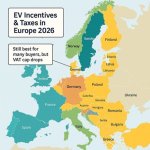
Buying an EV in Europe isn’t just about the sticker price it’s about VAT rules, registration taxes, annual ownership taxes, company-car taxation, and local bonuses. Two neighbors can pay wildly different “all-in” costs for the exact same car.
This 2026 guide gives you:
- a country snapshot (with the why behind it),
- a practical “cheapest ownership” way to compare,
- and what’s likely to change next.
For the full EU-wide list (all member states + extras), the most handy single reference is ACEA’s annual overview. ACEA
How to compare countries (the simple method that actually works)
When people say “Country X is cheapest for EV ownership”, they usually mean a mix of:
- Upfront incentives (purchase bonus / leasing support / scrappage)
- Upfront taxes avoided (VAT relief, registration tax relief)
- Annual taxes (road tax / ownership tax)
- Company-car rules (Benefit-in-Kind taxation can dwarf everything else)
- Charging perks (home charger credits, reduced electricity taxes, parking perks)
So the “best” country depends on who you are (private buyer vs business) and what you buy (cheap city EV vs premium SUV).
2026 country snapshots (the ones people compare most)
Norway (EEA, not EU) — still the EV tax king, but 2026 gets stricter
Norway remains the benchmark because the incentives hit the biggest lever: VAT. In practice, BEVs are VAT-exempt up to a price cap, and you pay VAT only above that cap. EAFO notes the VAT exemption continues through 2026 but with a lower exemption limit and a phase-out path.
What to expect in 2026 (headline):
- VAT exemption threshold drops (widely reported as moving from NOK 500k to NOK 300k in 2026).
Result: cheap/mid EVs stay very attractive; expensive EVs get noticeably pricier.
Denmark — expensive car market, but EV taxation stays “friendly-ish” in 2026
Denmark is famous for high car taxes, so EV relief matters a lot. For annual ownership tax, EAFO shows BEVs at DKK 840 in 2025 rising to DKK 920 in 2026 (for vehicles registered after 1 July 2021).
There’s also reporting that planned EV tax increases were postponed so 2026 stays closer to 2025 rules. Ayvens
Sweden — no “free money” bonus, but EVs avoid the worst penalties
Sweden’s direct purchase bonus ended earlier (Bonus-Malus bonus part removed), and the government’s own info makes clear the bonus scheme is essentially not the way it used to be. Transportstyrelsen
In plain terms: Sweden nudges EVs more via tax structure than big upfront checks.
Netherlands — 2026 is a big step-change in annual tax
The Netherlands has been gradually tightening EV tax advantages. EAFO states BEVs pay 25% of the standard motor vehicle tax (MRB) in 2025, then increase to 75% from 2026–2029.
So 2026 is the year many Dutch buyers feel EV ownership costs “normalize.”
France - incentives continue into 2026 (but the system has evolved)
France is continuing purchase support into 2026, with public reporting describing an extension of the ecological bonus approach (with eligibility and targeting details).
France is also clearly steering support toward the buyers who need it most, rather than blanket subsidies.
Germany - national purchase subsidies ended, but new support is being discussed/reshaped
EAFO notes Germany’s national BEV purchase subsidy (Umweltbonus) was discontinued. alternative-fuels-observatory.ec.europa.eu
At the same time, multiple outlets report proposals for new EV support targeted at income/price caps. electrive.com
Translation: Germany in 2026 may be less about universal bonuses and more about targeted affordability schemes.
Italy - some of Europe’s biggest announced bonuses (with conditions)
Italy has launched/announced major incentive programs, including high support when scrappage and income criteria apply. EAFO reported bonuses up to €11,000 for eligible private buyers with scrappage under certain conditions, and Reuters reported a program with support up to €10,000 for individuals and €20,000 for small businesses.
Italy can look amazing on paper but availability, timing, and eligibility rules matter.
Poland - strong EU-funded support (2025 program that shapes 2026 decisions)
Poland launched a large subsidy program funded under the National Reconstruction Plan, reported as PLN 1.6 billion, offering substantial purchase support for new BEVs (with different levels depending on buyer profile and conditions). alternative-fuels-observatory.ec.europa.eu
Quick comparison table (2026 “feel” in one glance)
| Country | 2026 “story” in one line | Biggest lever |
|---|---|---|
| Norway | Still best for many buyers, but VAT cap drops | VAT exemption cap |
| Denmark | EV taxes remain relatively stable; ownership tax rises slightly | Annual CO₂-based tax |
| Sweden | Fewer direct bonuses; EVs win via tax structure | Bonus-Malus / annual tax |
| Netherlands | EV annual tax advantage shrinks in 2026 | MRB increases to 75% |
| France | Purchase support continues into 2026 (more targeted) | Bonus/CEE-style support |
| Germany | Old bonus gone; new targeted schemes debated | Affordability programs |
| Italy | Potentially very high bonuses, often conditional | Scrappage + income caps |
| Poland | Big EU-funded subsidy program influences the market | Direct subsidy budgets |
Which European country is cheapest for EV ownership in 2026?
If you buy a mainstream EV (not luxury):
- Norway is still hard to beat because VAT is such a huge chunk of price even with a lower cap. alternative-fuels-observatory.ec.europa.eu/
- Denmark can be surprisingly competitive for certain EV price bands because registration/ownership tax design matters so much.
- France / Italy / Poland can become “cheapest” if you qualify for the strongest household- or scrappage-linked bonuses. electrive.com
If you’re a company-car driver (super common in Europe), you need to look at Benefit-in-Kind rules first in some countries, that’s the true make-or-break lever. For a structured country list, start with ACEA’s overview and then click through to local rules. ACEA
What’s likely to change after 2026?
Two big themes are clearly emerging:
- Less “everyone gets a bonus”, more “targeted help”
Germany and France are good examples of moving toward affordability/targeting logic rather than broad subsidies. - More non-cash perks and industrial policy
There’s active discussion at EU level around supporting smaller Europe-made EVs through benefits that aren’t always a simple purchase cheque (think: privileges, exemptions, category-based support).