

Compact SUV Battle: 2026 Toyota RAV4 vs. 2026 Hyundai Tucson
The compact SUV market has never been more competitive. As crossovers dominate global sales, automakers continue to push the limits of technology, design, and efficiency. For 2026, two of the biggest names — Toyota and Hyundai — are going head-to-head once again with their newest versions of the RAV4 and Tucson.
Both SUVs promise strong fuel economy, advanced safety systems, and hybrid powertrains. But which one truly deserves a spot in your driveway? Let’s dive into this detailed comparison and find out which compact SUV reigns supreme in 2026.
 Powertrain and Performance
Toyota RAV4 2026
Toyota continues to refine its proven hybrid technology. The 2026 RAV4 is expected to offer three main options:
- 2.5-liter gas engine (FWD/AWD)
- Hybrid AWD model
- Plug-in hybrid RAV4 Prime, producing around 302 horsepower
The standard hybrid powertrain combines power and efficiency with 0–60 mph in about 7.5 seconds for the base hybrid and 5.7 seconds for the Prime — impressive for a family SUV.
Toyota has focused on refining its e-AWD system for improved traction and responsiveness. The result is a smoother, more confident ride both on highways and light off-road terrain.
Estimated fuel economy:
- Hybrid: ~41 mpg city / 38 mpg highway
- RAV4 Prime (plug-in): 94 MPGe combined (electric + gas)
Hyundai Tucson 2026
Hyundai’s redesigned Tucson remains one of the most stylish and tech-loaded options in the class. The 2026 model will continue offering:
- 2.5-liter gas engine (187 hp)
- 1.6-liter turbo-hybrid (226 hp)
- Plug-in hybrid (261 hp)
The hybrid model balances power and economy, while the PHEV offers an electric-only range of around 35 miles — ideal for short commutes. Hyundai’s H-Trac AWD system delivers excellent grip and stability.
The ride feels slightly softer than the RAV4, giving Tucson a more comfort-oriented personality, especially in city driving.
Estimated fuel economy:
- Hybrid: ~39 mpg city / 37 mpg highway
- Plug-in Hybrid: 80–85 MPGe
Driving Experience
If you like a more energetic, sporty drive, the RAV4 Hybrid has a snappier throttle response, especially in its Sport mode. Its electric motors provide instant torque, and the steering feels more connected to the road.
On the other hand, the Tucson Hybrid focuses on refinement and quietness. Hyundai’s cabin insulation and suspension tuning create a smoother, quieter ride. Steering is light, ideal for city traffic or long commutes.
Verdict:
- For sportier handling, go with the RAV4 Hybrid/Prime.
- For comfort and smoothness, choose the Tucson Hybrid/PHEV.
Design and Interior
Toyota RAV4
The 2026 RAV4 maintains its rugged, adventure-ready stance — think squared fenders, bold grille, and high ground clearance. Inside, Toyota improves cabin materials and offers new two-tone interior color options and a larger 12.3-inch touchscreen.
There’s also a new digital instrument cluster, and Toyota’s latest infotainment software now supports wireless Apple CarPlay and Android Auto.
Cargo space remains excellent: around 37.6 cu ft behind the rear seats and over 69 cu ft with seats folded one of the best in class.
Hyundai Tucson
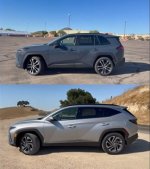
The 2026 Tucson continues to wow with its parametric design language sharp LED lighting, hidden DRLs, and geometric surfaces that give it a futuristic vibe. Inside, the dashboard is dominated by a sleek 12.3-inch curved display, dual climate touch controls, and ambient lighting.
The cabin feels more premium, especially in upper trims like Limited or Calligraphy, featuring soft-touch materials and ventilated seats.
Cargo space is slightly smaller than the RAV4: about 38 cu ft behind rear seats, 74 cu ft total still excellent for the segment.
Verdict:
- RAV4: rugged and practical
- Tucson: futuristic and luxurious
Safety and Technology
Both models lead the segment in safety tech.
Toyota RAV4 includes the latest Toyota Safety Sense 3.0, offering:
- Adaptive Cruise Control
- Lane Tracing Assist
- Road Sign Recognition
- Emergency Braking with Pedestrian Detection
- Highway Driving Assist 2
- Blind-View Monitor
- Remote Smart Parking Assist (self-parking feature)
- Surround View Monitor (360° camera)
Verdict: Tie both SUVs deliver class-leading safety and driver assistance.
Efficiency and Environmental Impact
Both SUVs are great choices for eco-minded drivers.
- The RAV4 Prime plug-in hybrid is still the efficiency king, offering over 40 miles of EV-only range and extremely low emissions.
- The Tucson PHEV trails slightly with 35 miles EV-only, but it charges faster and offers a more refined hybrid transition.
Practicality and Ownership Costs
Toyota RAV4:
- Proven reliability record routinely ranks in the top 3 compact SUVs for long-term dependability.
- Resale value among the highest in its class.
- Maintenance costs slightly lower thanks to Toyota’s hybrid system durability.
- Comes with one of the best warranties in the industry: 5 years/60 000 miles basic, 10 years/100 000 miles powertrain.
- Initial purchase price is typically a few thousand dollars less than an equivalent RAV4 trim.
Pricing (Estimated in USD, 2026 Models)
| Model | Base Price | Top Hybrid Trim | Plug-in Hybrid |
|---|---|---|---|
| Toyota RAV4 | $31 000 | $39 000 (Limited Hybrid) | $46 000 (RAV4 Prime XSE) |
| Hyundai Tucson | $30 000 | $38 000 (Limited Hybrid) | $43 000 (PHEV Limited) |
Final Verdict: Which SUV Wins the 2026 Battle?
Both the Toyota RAV4 2026 and Hyundai Tucson 2026 deliver outstanding value, efficiency, and comfort but they cater to slightly different buyers.
- Choose the Toyota RAV4 if you prioritize reliability, ruggedness, and proven hybrid performance. It’s the better all-rounder for outdoor lovers and long-term ownership.
- Choose the Hyundai Tucson if you want modern design, luxury features, and a smoother urban drive especially if you value tech and comfort over raw toughness.
Either way, both SUVs prove that the compact crossover segment is evolving faster than ever and in 2026, drivers truly can have it all: style, efficiency, and innovation in one package.