

Charging Speed vs. Real Range – Share Your Results
Electric vehicles are evolving faster than ever, yet two topics continue to spark debate among drivers: charging speed and real-world range. Manufacturers publish impressive numbers, but everyday use often tells a very different story. In this article, we break down how charging performance affects the actual kilometers (or miles) you can drive and why user-reported data is becoming more valuable than any lab test.
Why Charging Speed Matters More Than You Think
Many people assume that a higher kW rating means dramatically faster charging. While this is partly true, the reality is more complex:
- Peak power is only available for a short period.
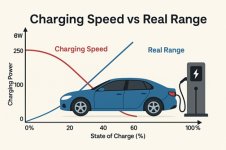
- What really matters is the charging curve, not the advertised maximum.
- Battery temperature, state of charge (SoC), and thermal management systems significantly affect speed.
- Fast chargers also vary in real output depending on load, weather, and network conditions.
In practice, two cars with identical peak charging power can produce entirely different results on the road.
Real Range: Why It Rarely Matches the Official Numbers
WLTP, EPA, or CLTC range figures are helpful for comparison but they rarely reflect daily driving. Real range is influenced by multiple dynamic factors:
- Speed, High-speed driving (120–130 km/h / 75–80 mph) can reduce range by 25–40%.
- Temperature, Extreme heat or cold decreases efficiency and increases energy consumption from climate control.
- Tires, Winter tires, incorrect pressure, and rolling resistance matter more than expected.
- Weight & Aerodynamics, Passengers, luggage, roof boxes, and bike racks all impact efficiency.
- Driving Style, Aggressive acceleration and braking rapidly drain the battery.
Because of these variables, real-world range can differ dramatically between drivers, routes, and seasons.
Charging Speed vs. Real Range - How Do They Connect?
There is a stronger relationship between these two elements than most EV owners realize.
1. Faster Charging Helps Offset Lower Highway Range
Many EVs consume much more energy at high speeds but if they can recharge quickly, the total trip time may still be competitive. This is why some cars with modest range but excellent charging curves outperform long-range models with slow charging.
2. The Best EVs Maintain High Charging Power Longer
The ability to hold 70–80% of peak charging power up to 40–50% SoC dramatically reduces charging times. Real range is important, but if your car charges fast from 10% to 60%, long trips become far more comfortable.
3. Weather Impacts Both Range and Charging
Cold batteries charge slower. Cold air increases drag. Hot weather forces cooling systems to work harder. Understanding seasonal patterns is key to planning realistic journeys.
4. Software Updates Can Change Everything
Many brands continuously optimize charging curves, efficiency, and thermal behavior through OTA updates. This is why community-shared data is essential for understanding current performance, not outdated reviews.
Why Your Experience Matters - Share Your Results!
No laboratory test can replicate real roads, traffic conditions, weather, or driving habits. That’s why community feedback is becoming the most powerful source of truth for EV buyers.
You can help other drivers by sharing:
- Your average consumption at different speeds
- Winter vs. summer range
- Real charging time from 10% to 80%
- How fast chargers in your region perform
- Road trip logs (distance, stops, state of charge, charge time)
The more users contribute, the more accurate and useful the collective data becomes.
How to Test and Report Your Own Results
To generate meaningful, comparable results:
- Choose a consistent test route (same direction, similar weather).
- Reset the trip computer before each run.
- Measure consumption at 90 km/h, 110 km/h, and 130 km/h (or local equivalents).
- Record a full 10–80% fast charge session, noting temperature and charging power changes.
- Report both time and gained range, not just kW.
- Include tire type, load, and outside temperature for accuracy.
This type of structured data helps identify patterns that official tests never show.
Final Thoughts
The relationship between charging speed and real range is one of the most important yet most misunderstood aspects of electric vehicle performance. A fast-charging EV with a stable charging curve can often outperform a long-range EV with slow charging capabilities on actual long-distance trips.
But no matter what the specs say, real-world results matter most. That’s why your experiences, measurements, and feedback are incredibly valuable for the EV community.
So now it’s your turn:
Charging Speed vs Real Range – what results have you seen? Share your data!
Last edited by a moderator: