

CATL & GEM (China): The Recycling Giants Powering Asia’s Circular Battery Economy (2026 Outlook)
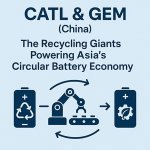
China isn’t just making the world’s EV batteries it’s also building the end-of-life machine that takes them back apart and turns them into new materials. Two names come up again and again when you look at scale, infrastructure, and “closed-loop” ambition: CATL (via Brunp) and GEM.
In 2026, they matter even more because the wave of retired batteries is turning from “coming soon” into “arriving now”.
Why CATL and GEM are so important for circularity
A circular battery economy needs four things working together:
- Collection networks (so batteries don’t vanish into informal channels)
- Safe dismantling + preprocessing (packs → modules → black mass / intermediate products)
- High recovery of critical metals (Ni/Co/Mn/Li — and increasingly graphite)
- Reintegration into manufacturing (recycled materials → cathodes/precursors → new cells)
CATL is strong on (1) and (4) because it sits at the center of manufacturing. GEM is strong on (2) and (3) as a specialist recycler/materials producer that plugs into many supply chains. Together, they’re basically “the highway and the refinery” of battery circularity in China.
CATL (Brunp): manufacturing-scale recycling, not boutique recycling
CATL’s recycling arm Brunp is built for industrial throughput. CATL states it has 240+ waste-battery collection depots and 270,000 tons of waste-battery disposal capacity (data as of Dec 31, 2024).
On recovery performance, reporting around 2024–2025 highlights extremely high yields:
- 99.6% recovery for nickel/cobalt/manganese
- 96.5% recovery for lithium
And importantly: this isn’t theoretical. Brunp reportedly processed over 120,000 tons of used batteries in 2024, and produced 17,100 tons of recycled lithium salts (reported by industry media).
What “government-backed infrastructure” looks like in practice
It’s not always a single subsidy you can point to it’s the system: traceability rules, standardization, compliance pressure, and the fact that China has been building a regulated EV battery recycling framework for years.
Brunp also positions itself inside that system: CATL says Brunp led/participated in a large share of China’s national standards work for battery recycling.
GEM: the “recycler + materials producer” model at huge scale
GEM has long marketed itself as a top-tier circular-economy player. The Ellen MacArthur Foundation case example cites GEM processing ~300,000 tonnes/year of waste batteries (noting it as 10%+ of total waste batteries, per that source). ellenmacarthurfoundation.org
More recent company reporting shows operational activity and a very “closed-loop” direction:
- GEM reports it recycled and dismantled 23,000 tons of power batteries (2.63 GWh) in the first three quarters of 2024 (+16.78% YoY).
- It also describes a “directional recycling” system linking battery plant → battery waste → material recycling, and notes strong utilization for directional recycling ternary cathode production. en.gem.com.cn
GEM has also been expanding industrial capacity: Argus reported a GEM-linked complex planned with 100,000 t/yr capacity for decommissioned power batteries & scrap, plus 50,000 t/yr for used LFP material and 3 GWh/yr for used energy storage battery packs.
2026: what changes (and why the numbers get serious)
1) Retired battery volumes keep climbing
Chinese media reporting cites forecasts that retired power batteries reach ~1.04 million tonnes in 2025 and may surge to ~3.5 million tonnes by 2030.
A simple “constant growth” estimate using that 2025→2030 trajectory implies ~27% CAGR, which would put 2026 retired volumes around ~1.3 million tonnes (rough estimate, not an official forecast). english.news.cn
What that means in plain language: 2026 is when recycling stops being a niche industry and becomes essential national infrastructure.
2) Safety + compliance standards tighten (more regulated inputs)
China is set to introduce stricter mandatory EV battery safety standards effective July 1, 2026 (including requirements aimed at reducing fire/explosion risk). That doesn’t “directly” mandate recycling but it pushes manufacturers toward better lifecycle control, traceability, and safer handling at end-of-life. electrive.com
3) Value shifts: LFP rises, lithium recovery becomes more important
As LFP dominates many mass-market EVs, recyclers can’t rely only on cobalt economics. That’s one reason lithium recovery rates, process efficiency, and scaling logistics are such a big deal — and why CATL/Brunp’s published lithium recovery figures get attention. CnEVPost
What to expect next from CATL & GEM (2026–2028)
Most likely developments:
- Bigger preprocessing + dismantling automation (speed + safety + lower cost per ton)
- More closed-loop contracts (OEMs and battery makers locking in recycled feedstock)
- Standard-driven consolidation (harder for informal players to compete as compliance tightens) IEA
- Capacity race: CATL’s stated disposal capacity (270k tons) and Brunp’s reported 2024 throughput (120k tons) show headroom for growth and GEM’s multi-country footprint suggests similar scaling pressure.
One more “macro” indicator: China’s power battery recycling market size was reported as 48 billion yuan+ in 2024 with recycled power batteries 300,000 tons+, and projections pointing to 100 billion yuan+ by 2030 (industry association reporting).
The real takeaway (for investors, operators, and policy people)
If you care about a circular battery economy in Asia, CATL and GEM are not optional. They are the kind of players who can make circularity “boringly reliable” — the way municipal water systems are reliable because they combine:
- scale,
- integration into manufacturing,
- collection + processing networks,
- and alignment with a tightening standards environment.
2026 is when the retired-battery wave becomes big enough that the winners won’t just be the best chemists they’ll be the best systems builders. CATL and GEM are already playing that game.
References (links)
CATL recycling overview (capacity, depots; data as of Dec 31, 2024)Brunp recovery rates + 2024 processing volume (industry reporting)
GEM capacity example (Elltion caseen MacArthur Founda):
GEM expansion project (Argus, 2023):
China traceability / policy context (IEA + UNECE)
Retired battery volume forecasts (2025 and 2030)
China battery safety standards effective July 1, 2026 (electrive)
Market sizing note (CNESA, 2024 recycled volume + value; 2030 projection)